Quick Summary
- Tree preservation orders (TPOs) are legal restrictions that prevent the unauthorized removal or pruning of protected trees.
- Understand the legal consequences of performing work on a protected tree without the necessary council consent.
- Learn how to identify if your trees are subject to a TPO and how the application process for tree work functions.
- Discover why professional guidance is essential to avoid hefty fines and ensure your garden remains compliant.
- See how experts can manage the administrative burden of local planning applications on your behalf.
Why Legal Compliance Matters for Your Trees
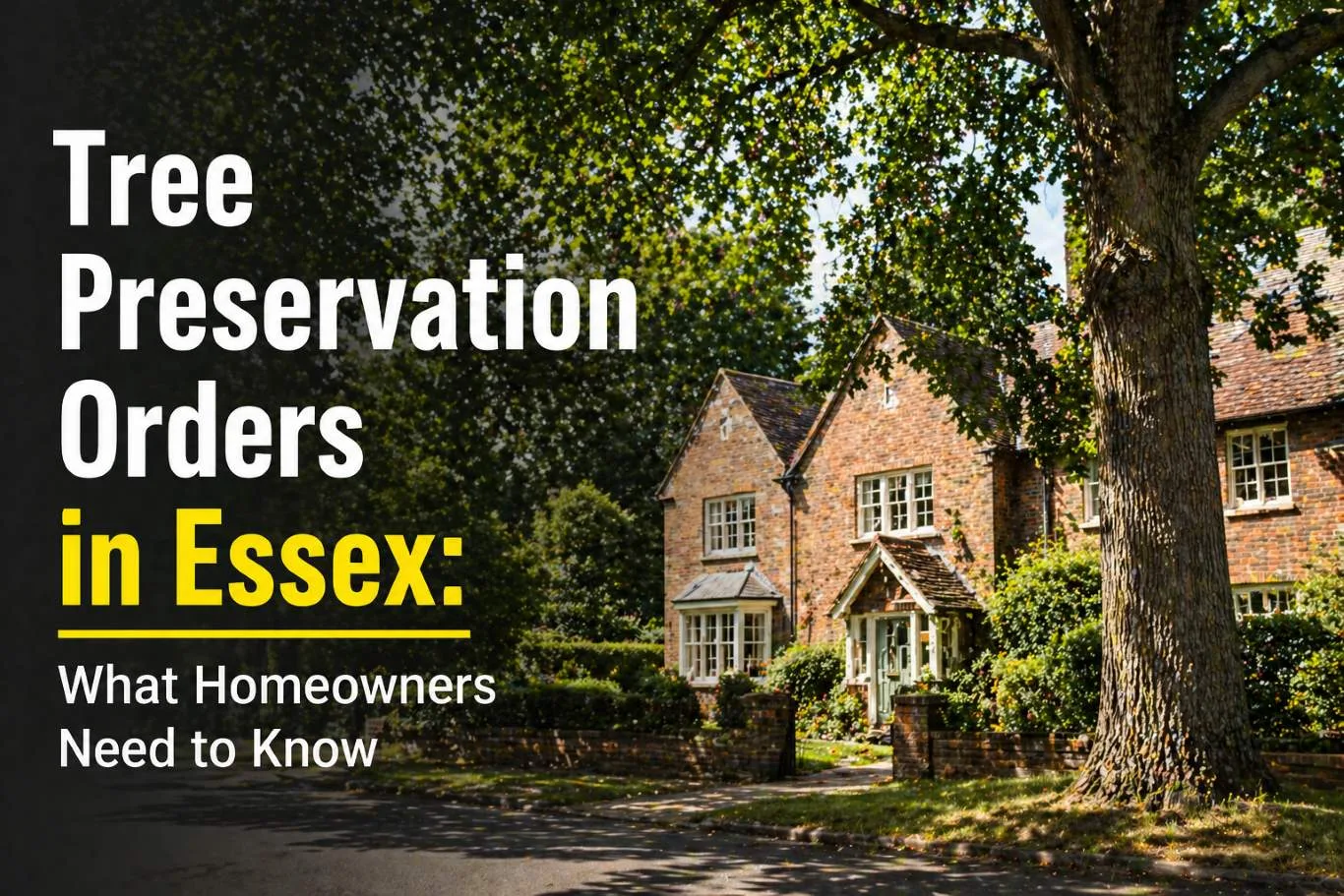
For many homeowners, the trees in their garden are an extension of the family home, offering shade, privacy, and aesthetic beauty. However, when those trees become a point of concern—perhaps they are blocking light or showing signs of decay—it is vital to check their legal status before picking up a saw. In many parts of the country, local councils implement tree preservation orders to protect trees that make a significant contribution to the local landscape. Understanding these legal safeguards is crucial, and at Chigwell Tree Services, we specialize in helping property owners navigate the complex rules surrounding tree preservation orders in Essex. Whether you are planning a routine trim or require urgent removal, we ensure your project remains fully compliant with all local planning requirements.
Navigating TPO regulations can be complex; contact our experts today to ensure your tree work is fully compliant and stress-free :
What Exactly Is a Tree Preservation Order?
At its core, a TPO is an order made by a local planning authority (your local council) to protect specific trees, groups of trees, or even entire woodlands. The primary goal is to ensure that the character and amenity of an area are not diminished by the indiscriminate removal of trees.
Why Are Trees Protected?
Not every tree gets a TPO. Councils typically focus on trees that are visible from a public road or footpath and contribute to the overall visual appeal of the neighborhood. A tree might be protected because of its size, its historical significance, or its role in supporting the local ecosystem. When a TPO is in place, it becomes a criminal offence to cut down, top, lop, uproot, or willfully damage or destroy the tree without getting express permission from the council first.
How to Determine if Your Tree is Protected
Many homeowners move into a new property without knowing the history of their garden trees. It is a common mistake to assume that because a tree is on your private land, you have total autonomy over it.
Checking the Council’s Register
Every local council in the UK maintains a register of TPOs. Most councils now have an online portal or an interactive map where you can search by your postcode or address. If you are unsure, it is always best to contact your local planning department directly or speak with a professional who can conduct a search on your behalf.
Conservation Area Constraints
It is worth noting that even if a tree does not have a specific TPO, it might still be protected if your property is situated within a designated Conservation Area. In these instances, you are legally required to give the council six weeks' notice before performing any work. This is often referred to as a “Section 211 Notice.” If you are unclear about whether your home sits within these boundaries, an experienced arborist can clarify this for you immediately.
The Application Process: Navigating the Red Tape
Dealing with local government planning departments can feel overwhelming, but it is a necessary step when working with protected trees.
What the Council Expects
When you submit an application to carry out work on a TPO tree, you aren't just sending a letter; you are providing a formal request. The council will expect:
- A precise description of the work you want to do (e.g., crown reduction by 20%).
- A clear justification for the work (e.g., the tree is diseased, or it is causing structural damage to a wall).
- A sketch plan showing the tree's location and the extent of the proposed cuts.
The Role of Professional Support
This is where the expertise of a professional firm like Chigwell Tree Services becomes invaluable. We don't just perform the physical work; we act as your advocate. We can provide the arboricultural evidence required to support your application, ensuring that the request is framed in a way that the council's planning officer is more likely to approve. By providing a clear, evidence-based case, we minimize the chances of your application being rejected due to incomplete or poorly communicated information.
Understanding the Broader Legal Context
The framework for these protections is standardized across the country, but the implementation rests with local authorities. When discussing tree preservation orders in the UK, it is important to remember that these laws were designed to prevent the short-sighted destruction of valuable natural assets. While it can be frustrating to have to ask for permission to prune a tree in your own garden, these laws are there to prevent the gradual “greying” of our neighborhoods.
The Consequences of Non-Compliance
The penalties for carrying out unauthorized work on a TPO-protected tree are severe. Homeowners have been known to face fines amounting to tens of thousands of pounds, and in extreme cases, they may be required to plant a replacement tree that is subject to the same protections as the one that was removed. Worse yet, some councils may insist that the replacement tree be of a specific species and size, further limiting your landscaping choices. Given the risks, “playing it safe” is always the best financial and legal strategy.
What If Your Tree is Damaged or Diseased?
There is a common misconception that TPOs prevent any work from being done. This is not the case. If a tree is dead, dying, or dangerous, the council will usually allow work to proceed much more quickly.
The “Dead and Dangerous” Exemption
If a tree poses an immediate threat to people or property, you can technically perform the work without waiting for a full application process. However, you must still be able to prove that the tree was in that condition if challenged. Always take high-quality photographic evidence before and during the work, and inform the council of your intentions as soon as possible. Because the burden of proof lies with the homeowner, many of our clients prefer to have one of our arborists inspect the tree and provide a written report confirming that the work was an emergency. This serves as your “insurance policy” against future council inquiries.
How Experts Enhance Your Garden Management
Beyond legal compliance, professional intervention ensures that the work is carried out to British Standard BS 3998:2010. This standard dictates the recommended practices for tree work, ensuring that the health of the tree is prioritized during the pruning process.
Enhancing Health and Vigor
A professional arborist knows exactly how much crown reduction a tree can tolerate without going into shock. When we work on protected trees, we do so with an eye toward the future, ensuring that the tree remains a safe and healthy asset for decades to come.
FAQs
Q1: How long does it take for the council to process a TPO application?
Typically, you should expect a decision within eight weeks from the date the application is validated by the local authority. It is best to factor this into your garden project timeline.
Q2: What areas do you provide coverage for?
We offer extensive coverage throughout Essex and the surrounding regions. Our team is well-versed in the specific local planning policies of each Essex district, which helps us navigate the application process more efficiently.
Q3: How soon can you visit my property to check for TPOs?
We aim to conduct site visits and assess your trees within 24 to 48 hours of your inquiry. If you suspect your tree is dangerous, we prioritize these assessments to ensure your property remains safe.
Q4: Are you able to handle the entire application process for me?
Yes. From filling out the forms and drawing the site plans to submitting the application and liaising with the council planning officer, we handle the administrative burden from start to finish.
Q5: Does my tree species affect the likelihood of approval?
The species is less important than the “amenity value” of the tree. A common tree species can have high amenity value if it sits on a prominent corner plot, whereas a rare species might be ignored if it is hidden deep within a back garden.
Conclusion / Final Thoughts
Living with a protected tree doesn't have to be a source of anxiety. Once you understand the rules and have a professional partner to guide you through the process, managing your trees becomes a straightforward, manageable task. Whether you are dealing with a routine maintenance schedule or an emergency that requires urgent action, knowledge is your most powerful tool. At Chigwell Tree Services, we bring the experience, the technical skill, and the administrative expertise to handle your tree preservation orders with total professionalism. If you are looking for reliable affordable tree services near me or need expert tree surgeons near me to help clarify the legal status of your garden, our team is ready to assist. We prioritize your property’s safety and compliance, ensuring that your trees remain a beautiful, legal, and healthy part of your home for years to come.