Quick Summary
- Discover why planting high water-demand trees close to residential foundations is the leading cause of clay soil subsidence across England and Wales.
- Identify the worst trees to plant near a house in the UK, including Oak, Willow, Poplar, Leyland Cypress, and Eucalyptus.
- Understand the vital difference between indirect foundation damage (soil shrinkage on shrinkable clay) and direct mechanical damage (drain invasion and paving lift).
- Learn why property owners must never rush into sudden tree felling if cracking appears, to avoid triggering catastrophic “ground heave”.
- Explore safe, RHS-recommended low water-demand ornamental species ideal for small suburban boundaries and urban plots.
Introduction
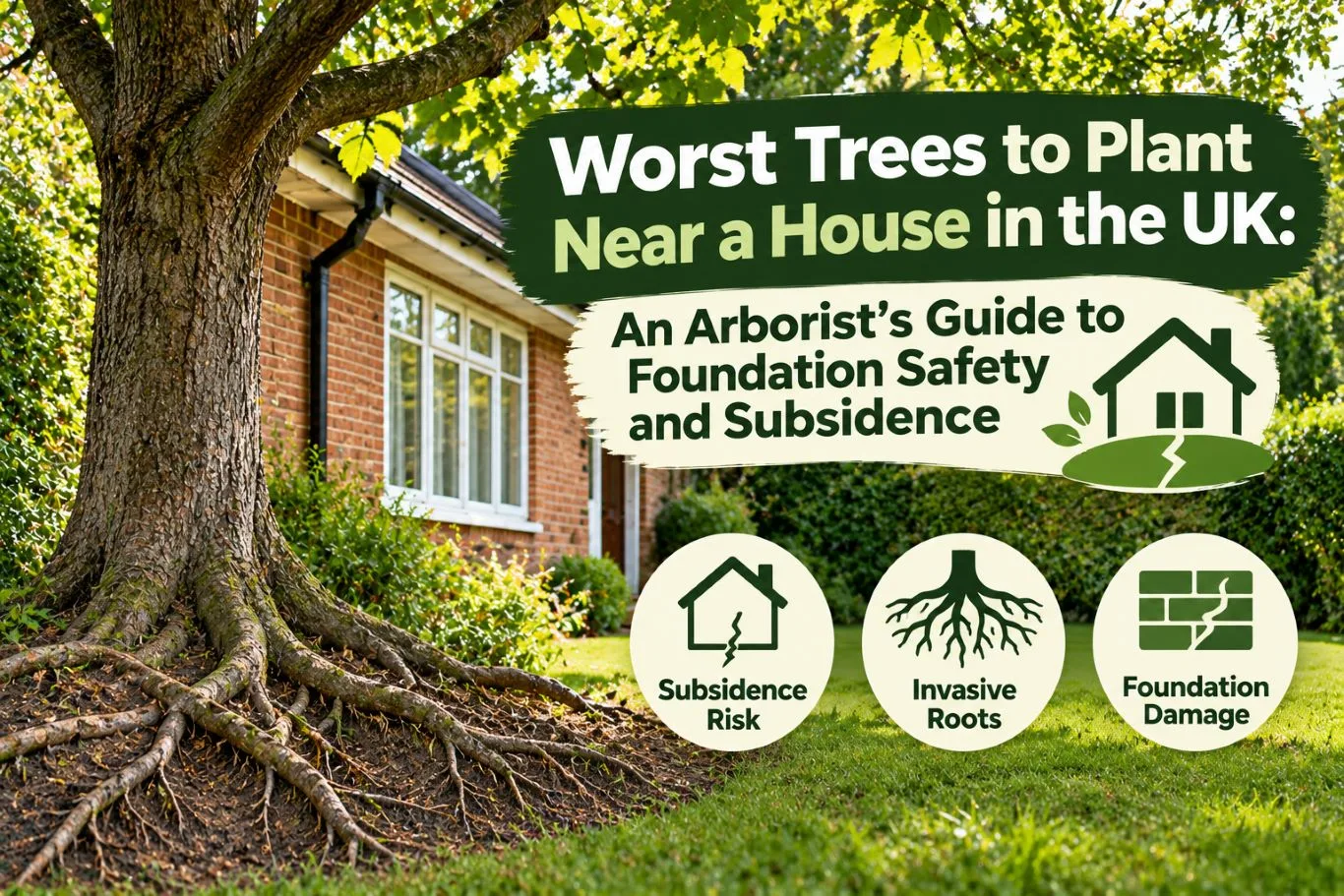
A mature tree adds undeniable grace, seasonal colour, and ecological richness to a British garden. Yet, when planted carelessly close to brick foundations, underground drainage runs, or shared party walls, the wrong species can quickly become an expensive structural hazard. In the UK, foundation movement linked to vegetation is heavily concentrated across regions dominated by shrinkable clay soils, notably London, the Home Counties, and the South East. For homeowners, understanding which specimens represent the worst trees to plant near a house in the UK is essential to protect structural integrity and avoid costly insurance disputes. At Chigwell Tree Services, our certified arborists deliver dependable, affordable, and professional tree services for residential & commercial properties across Essex, North London & East London, ensuring your garden trees remain beautiful, safe, and fully compatible with the architecture surrounding them.
Worried a mature tree is growing too close to your foundations or drains? Chat with Chigwell Tree Services on WhatsApp for expert arboricultural advice across Essex, East London, and North London :
How Tree Roots Cause Foundation Damage: Subsidence vs Heave
A common misconception among homeowners is that tree roots physically “push” concrete footings apart. In reality, modern foundation concrete is far too dense for fibrous roots to penetrate directly. Instead, the danger is almost entirely indirect, driven by moisture extraction from shrinkable clay subsoils.
The Mechanics of Subsidence on UK Clay Soils:
- Soil Moisture Extraction: In hot, dry summer months, thirsty trees extract hundreds of litres of moisture from the ground every day.
- Volumetric Clay Shrinkage: As water is pulled from shrinkable clay, the subsoil contracts and drops in volume beneath footings.
- Foundation Movement: Without uniform soil support, shallow foundations (especially those built before the 1950s) sink unevenly, causing diagonal wall cracks.
- Seasonal Cycling: Winter rainfall often swells the clay back up, leading to cracks that open in August and close in January.
The Threat of “Ground Heave”
If you discover diagonal cracking on your external masonry, your immediate instinct might be to chop down the adjacent tree. However, arborists and structural engineers strongly advise against knee-jerk felling. If a mature tree that has produced a permanent, deep soil-moisture deficit over decades is suddenly removed, the desiccated clay rehydrates and expands. This upward ground swelling—known as ground heave—exerts upward pressure against house footings, frequently inflicting structural damage far more severe than the original subsidence.
The 5 Worst Trees to Plant Near a House in the UK
According to guidance from the Royal Horticultural Society (RHS) and arboricultural research, trees are categorised by water demand. The species below rank in the highest-risk tier:
1. Oak (Quercus robur and Quercus petraea)
- The Risk: English Oak is behind more subsidence claims in the UK than any other single tree species.
- The Root System: A mature oak develops an immense root plate that can extend 30 to 40 metres from the main stem, searching continuously for groundwater.
- Safe Planting Distance: Keep large oaks at least 30 metres away from any habitable structure or outbuilding, particularly on heavy clay soils.
2. Willow (Salix species, including Weeping Willows)
- The Risk: Willows possess an unquenchable thirst, with mature specimens drinking upwards of 1,000 litres of water daily during peak summer.
- Drain Invasion: In addition to shrinking subsoils, willows produce aggressive, fine adventitious roots that actively sniff out moisture leaks in older vitreous clay pipes and septic lines, causing severe drain collapse.
- Safe Planting Distance: Plant willows no closer than 40 metres from residential foundations or underground drainage networks.
3. Poplar (Populus species, including Lombardy Poplar)
- The Risk: Famous for explosive growth rates of up to 2.5 metres per year, poplars demand massive amounts of soil moisture to sustain their rapid leaf expansion.
- Foundation Impact: Because they grow rapidly, their expanding lateral root systems dry out subsoils quickly, causing noticeable subsidence around driveways and shallow footings.
- Safe Planting Distance: Maintain a minimum clearance of 30 to 35 metres from buildings.
4. Cypress (Cupressus, Chamaecyparis, and Leylandii)
- The Risk: While widely planted as fast-growing privacy screening, Leyland Cypress (x Cuprocyparis leylandii) can exceed 30 metres in height if unmanaged.
- Structural Liabilities: Dense conifer rows draw continuous moisture year-round because they do not drop their foliage. Furthermore, their shallow, sail-like root plates are vulnerable to windthrow during gales, threatening boundary fences and roofs.
- Safe Planting Distance: Avoid planting conifer rows within 15 to 20 metres of houses unless subject to a strict annual trimming regime.
5. Eucalyptus (Eucalyptus globulus and gunnii)
- The Risk: Native to Australia and historically planted in wetlands to drain standing water, eucalyptus trees have an aggressive thirst.
- Garden Behaviour: In UK soils, eucalyptus trees grow at astonishing speed, stripping surrounding garden borders of moisture and lifting paving, patios, and light brick boundary walls within just a few seasons.
- Safe Planting Distance: Keep at least 15 to 20 metres away from brickwork.
Species Water-Demand & Distance Comparison
| Tree Species | Water Demand (RHS Classification) | Typical Mature Spread | Subsidence Hazard on Clay Soil | Recommended Minimum Distance |
| Oak | High | 20m – 30m | Very High (Accounts for most UK claims) | 30m |
| Willow | High | 15m – 25m | Extreme (Severe drain & soil impact) | 40m |
| Poplar | High | 15m – 20m | Very High (Rapid seasonal drying) | 30m |
| Leyland Cypress | High | 10m – 15m (untrimmed) | High (Continuous evergreen thirst) | 15m |
| Eucalyptus | High | 10m – 15m | High (Rapid subsoil depletion) | 15m |
| Silver Birch | Moderate | 6m – 10m | Low to Moderate | 8m – 10m |
| Rowan / Mountain Ash | Low | 4m – 7m | Very Low | 4m – 6m |
Safe, Low Water-Demand Alternatives for UK Gardens
If you wish to enjoy the screening, shade, and wildlife benefits of trees without compromising your home's structural stability, the Royal Horticultural Society recommends low water-demand, non-invasive species:
RHS-Approved Trees for Small Boundaries & Clay Soils:
– Amelanchier lamarckii (Juneberry): Stunning spring blossom, compact root system, ideal for small front gardens[cite: 8].
– Acer palmatum (Japanese Maple): Shallow, non-aggressive roots, exceptional autumn colour, highly suitable near patios[cite: 8].
– Magnolia (e.g., Magnolia stellata): Slow-growing, non-invasive roots that exert minimal pressure on clay subsoils[cite: 8].
– Corylus avellana (Hazel): Easily coppiced, low water demand, excellent for natural privacy screening[cite: 8].
– Liquidambar styraciflua (Sweetgum) / Morus (Mulberry): Compact broadleaves that tolerate suburban garden spaces safely[cite: 8].
Managing Existing Trees Near Buildings
If your property already has a large oak, willow, or conifer boundary growing close to brickwork, felling is not the only option. Certified arborists apply tailored arboricultural interventions to manage moisture uptake and crown sail:
- Crown Reduction and Thinning: Systematically reducing a tree's leaf volume lowers the overall surface area dedicated to transpiration, reducing the volume of moisture the root system draws from the subsoil.
- Root Barrier Installation: Where space permits, trenching and installing specialised semi-permeable geomembrane root barriers can divert root growth away from domestic footings and utility trenches.
- Professional Condition Reports: Routine arboricultural surveys monitor tree health, evaluate structural balance, and establish whether historical movement is active subsidence or benign thermal settlement.
FAQs
1. How do I know if tree roots are causing cracks in my home?
Tree-related subsidence cracks typically run diagonally, are wider at the top than at the bottom, and frequently appear around external door frames and window reveals. A tell-tale sign of vegetation-related movement is seasonal behaviour: cracks that open up during dry summer months and narrow or close after prolonged winter rain re-wets the clay.
2. Can tree roots break through modern concrete foundations?
Virtually never. Modern concrete footings built after 1980 are engineered to depths that tree roots cannot penetrate. The primary risk is to older properties (built before the 1950s) that sit on shallow footings over shrinkable clay soils, where soil shrinkage removes physical support beneath the building.
3. How quickly can your arborists inspect a tree suspected of causing subsidence?
We maintain a responsive local team across our operational network. Our qualified arborists can typically attend your residential or commercial property within 24 to 48 hours to carry out a comprehensive visual tree inspection and provide a detailed risk report.
4. Which regional areas do your tree inspection teams cover?
Our daily operational footprint covers all of Essex—including Chigwell, Loughton, Woodford, Buckhurst Hill, Epping, Brentwood, Romford, and Chelmsford—alongside adjacent North London and East London boroughs.
5. Who pays for damage if my neighbour's tree roots cause subsidence to my home?
Under UK common law, a tree owner is legally responsible for foreseeable damage caused by their tree's roots encroaching onto neighbouring land. However, establishing legal liability requires formal arboricultural and structural evidence proving the encroachment caused the specific damage. You should notify your building insurer immediately so their loss adjusters and arborists can investigate the cause and liaise with the tree owner.
Conclusion / Final Thoughts
Selecting the right tree for the right location is the single most important decision a homeowner can make for long-term property safety. While magnificent in open parklands, high water-demand varieties represent the worst trees to plant near a house in the UK when planted too close to shallow foundations on shrinkable clay. By understanding tree biology, monitoring seasonal movement, and selecting well-behaved ornamental alternatives, you can enjoy a lush, green landscape without putting your home at risk[cite: 8].
At Chigwell Tree Services, our experienced team delivers reliable, professional tree services for residential & commercial properties across Essex, North London, and East London. Whether you need a professional subsidence risk assessment, crown reductions to manage water uptake, or safe sectional dismantling of high-risk trees, our certified arborists provide honest, science-backed guidance. Protect your foundations and ensure your garden thrives safely—contact our friendly specialists today to book your free, no-obligation site consultation.