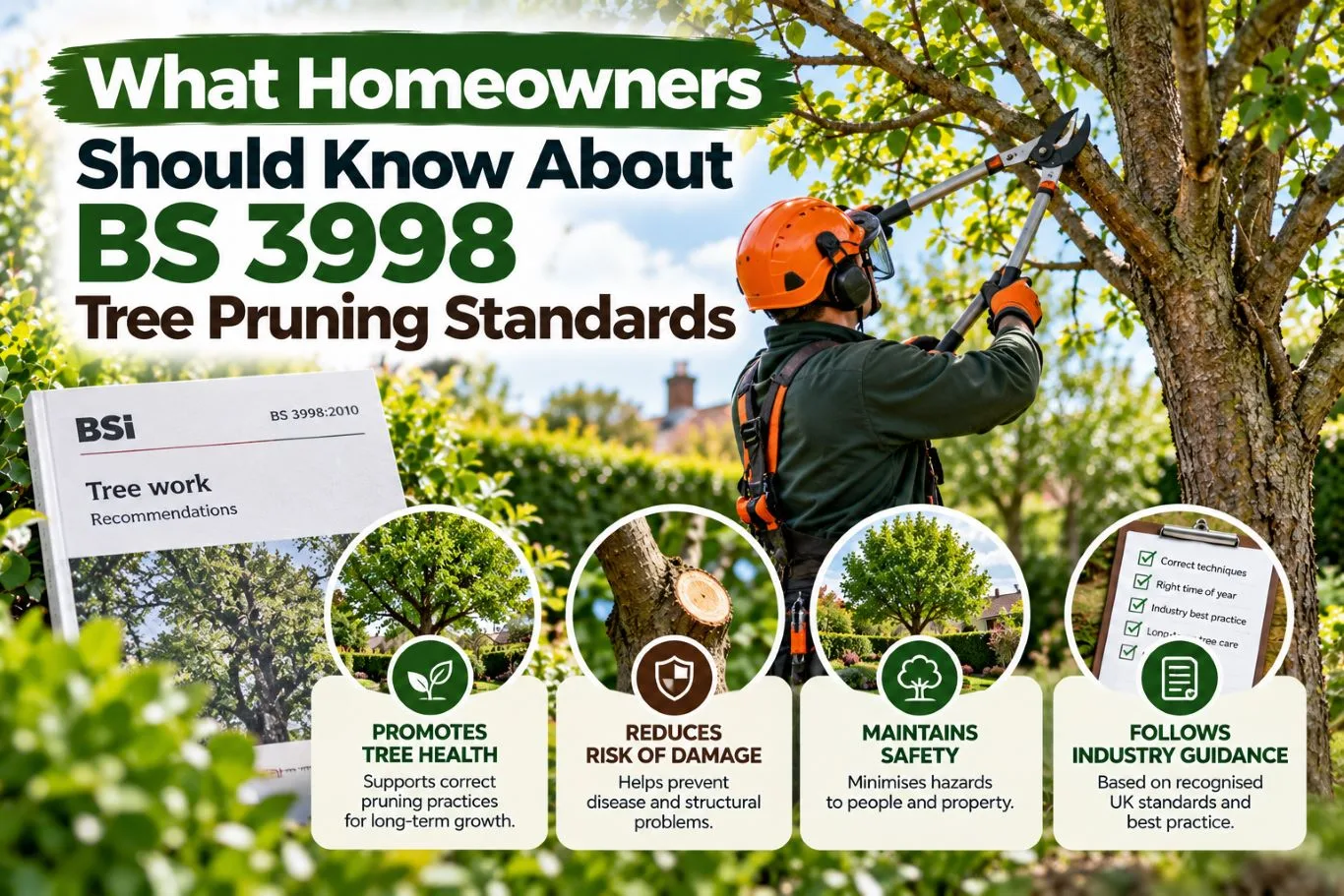
Quick Summary
- Understanding BS 3998 tree pruning standards ensures your garden trees receive scientifically sound care rather than damaging, arbitrary cuts.
- Published by the British Standards Institution, BS 3998 sets the definitive national benchmark for modern arboricultural operations across the UK.
- Learn how British Standard compliance prevents devastating practices like “topping” and “lopping” that lead to internal rot and weakly attached regrowth.
- Explore core operations defined under the standard, including crown thinning, crown reduction, crown lifting, and selective deadwood removal.
- Discover why local planning authorities require BS 3998 compliance for all works on trees protected by Tree Preservation Orders (TPOs) or within Conservation Areas.
Introduction
When booking tree work for your garden, it can be difficult to tell the difference between a qualified arboricultural craftsman and an uninsured operator with a chainsaw. Anyone can buy cutting equipment, print flyers, and claim to trim trees, but improper pruning causes irreversible structural decay, invites fungal pathogens, and can shorten a mature tree's lifespan by decades. To protect landowners, the urban forest, and professional contractors, the UK established a benchmark: British Standard BS 3998 (Tree Work – Recommendations). Adhering to BS 3998 tree pruning standards guarantees that every cut is carried out with clear biological justification, respecting the tree’s natural biomechanics and ability to heal. At Chigwell Tree Services, our certified arborists deliver dependable, affordable, and expert tree services for residential & commercial properties across Essex, East London & North London / UK and surrounding areas, ensuring every domestic and commercial project complies fully with modern British Standards.
Want to ensure your trees receive certified, British Standard care rather than damaging cuts? Chat with Chigwell Tree Services on WhatsApp for expert pruning advice across Essex, East London, and North London :
What Is BS 3998?
Originally introduced in 1966 and substantially revised to reflect modern arboricultural science in 2010 (BS 3998:2010), this document is the authoritative national code of practice for tree surgery in the United Kingdom.
Core Principles of BS 3998:
- Biological Consideration: Pruning must account for species, age, physiological vitality, and natural growth habit.
- Minimal Wounding: Cutting should minimise exposed surface area to encourage natural compartmentalisation.
- Structural Retention: Preserve the tree's natural balance and wind-dampening architectural framework.
- Habitat Conservation: Assess veteran trees and deadwood for biodiversity value before removal.
- Safety Compliance: Ensure all works protect climbing teams, the public, and adjacent property.
Rather than treating a tree like an inanimate wooden post, British Standard tree pruning considers the living tree as an integrated biological system. It guides the arborist on how much foliage can be safely taken down, where cuts must be positioned, and when specific operations should be scheduled throughout the calendar year.
The Danger of Non-Standard Pruning: Topping vs BS 3998
To appreciate the necessity of tree pruning standards UK, consider the harmful practice known as “topping” or “lopping.”
| Non-Standard “Topping & Lopping” | BS 3998 Standard Pruning |
| Amputates main upright limbs at indiscriminate, arbitrary heights. | Retains the natural crown architecture by pruning back to lateral growth points. |
| Leaves broad, flat wounds that cannot heal, creating large pockets of wood rot. | Cuts cleanly outside the branch bark collar, stimulating rapid callus formation. |
| Removes large amounts of photosynthesising foliage, starving the root plate. | Limits foliage removal to safe biological thresholds (rarely exceeding 20% to 30%). |
| Triggers an explosion of weak, vertical water shoots prone to storm failure. | Directs natural energy into existing limbs, preserving wind resilience. |
| Ruin the natural silhouette, leaving an ugly, butchered stump structure. | Preserves an aesthetically pleasing, species-characteristic canopy. |
When an unqualified contractor tops a tree to “let light in,” they trigger a physiological emergency. In response, the tree draws on stored root starches to generate dense clusters of weakly attached shoots. Within three seasons, the crown becomes denser and darker than before, and those shoots carry a high risk of snapping in heavy gales, creating genuine hazards for gardens and homes below.
Approved Pruning Operations Under BS 3998
Under BS 3998 tree work recommendations, general phrases like “give it a good prune” are replaced by precise, measurable arboricultural definitions:
1. Crown Reduction
Crown reduction decreases the overall height and lateral spread of the canopy while maintaining its natural structural balance. BS 3998 specifies that reductions should be stated in specified metric dimensions (e.g., “reduce canopy height by up to 2.5 metres and radial spread by up to 1.5 metres”) rather than ambiguous percentage terms. Pruning cuts must terminate at a growing lateral branch that is at least one-third the diameter of the removed branch, allowing the limb to sustain sap flow without dying back.
2. Crown Thinning
Crown thinning involves the selective removal of small, secondary branches evenly throughout the crown, without changing the outer dimensions or height of the tree. The standard recommends a maximum foliage removal threshold (typically 10% to 20%), focusing on crossing, rubbing, or crowded branches. This allows light to penetrate through to garden borders below and reduces the canopy's aerodynamic wind-sail resistance during severe storms.
3. Crown Lifting
Crown lifting is the removal of the lowest branches to provide vertical clearance underneath the canopy. BS 3998 recommends avoiding clearance of more than one-third of the total tree height, ensuring the ratio of clear stem to crown framework remains structurally sound and visually balanced. It is commonly deployed over driveways, footpaths, and residential roofs.
4. Deadwood Removal
Deadwooding is the systematic extraction of dead, dying, or diseased branches throughout the canopy. While deadwood provides valuable microhabitats for native wildlife, branches that present an unacceptable hazard to public paths, conservatories, or parking bays must be pruned back to live tissue outside the branch collar.
Cutting Anatomy: Why Placement Matters
One of the most critical aspects of BS 3998 tree pruning is cut placement. Trees do not “heal” damaged tissue in the way human skin does; instead, they seal off wounds through a natural defence process known as CODIT (Compartmentalization Of Decay In Trees).
To support this natural defense:
- Never Make Flush Cuts: Cutting completely flush against the parent trunk slices through the branch collar (the swelling of parent tissue containing specialised chemical defences). Damaging this zone allows internal fungal rot to move straight into the heartwood of the main trunk.
- Never Leave Branch Stubs: Leaving a long, protruding branch stub prevents wound wood (callus tissue) from rolling over the wound. The dead stub eventually rots, creating an open pathway for moisture and decay to penetrate inward.
- Preserve the Branch Bark Ridge: The pruning cut should be made just outside the branch bark ridge and branch collar, angled slightly downward away from the stem to encourage natural water runoff and rapid sealing.
BS 3998 and Legal Council Planning Requirements
For property owners dealing with statutory tree protections, adhering to tree pruning guidelines is not merely good practice—it is often a legal necessity:
Statutory Tree Protection Requirements:
– Tree Preservation Orders (TPOs): Local Planning Authorities (LPAs) require formal applications specifying proposed works in BS 3998 terms.
– Conservation Areas: Homeowners must provide 6 weeks' formal notice (Section 211 Notice) detailing precise BS 3998 pruning specifications.
– Rejected Proposals: Vague requests such as “lop tree by half” are routinely rejected by municipal tree officers due to lack of standard compliance.
When local planning authorities evaluate applications to prune protected trees, they expect clear, measurable terminology compliant with BS 3998. Submitting specifications drawn directly from national standards ensures your application is processed without unnecessary delays or rejections.
For private homeowners, commercial premises, and estate managers across the region, scheduling dedicated professional tree pruning services for residential & commercial properties across Essex, North London & East London ensures complete planning assistance, liaison with municipal tree officers, and certified workmanship from start to finish.
How to Verify That Your Contractor Follows BS 3998
When obtaining quotes for tree maintenance, verifying that your chosen team works to national standards is the best way to safeguard your investment:
- Itemised Written Quotations: Look for clear, defined BS 3998 terminology (e.g., “crown reduction by 2m to suitable growth points”, “crown thin by 15%”), rather than vague descriptions like “cut back and tidy”.
- NPTC / City & Guilds Qualifications: Ensure climbing teams hold valid industry certificates for chainsaw operations at height (CS30, CS31, CS38, CS39).
- Comprehensive Public Liability Insurance: Reputable professional tree surgeons hold at least £5m to £10m in specialized public liability insurance underwritten specifically for aerial arboricultural works.
- Waste Disposal Licences: Ensure the contractor holds a registered Upper Tier Waste Carrier licence with the Environment Agency to prevent fly-tipping liabilities.
Relying on certified professional tree pruning guarantees that your garden trees are treated with scientific care, preserving their natural beauty, biological health, and structural safety for decades to come.
FAQs
1. Is BS 3998 a legal requirement for tree surgery on private property?
BS 3998 is a voluntary national standard rather than a statutory law for unprotected trees on private land. However, it is the universal benchmark used by UK courts, insurers, and municipal councils to determine professional competence and quality of workmanship. If a tree is protected by a Tree Preservation Order (TPO) or is within a Conservation Area, compliance with BS 3998 is almost universally required by local planning authorities.
2. Can an old, mature tree handle a heavy crown reduction under BS 3998? The standard recommends against heavy reductions on mature or veteran trees with low vitality. Older trees possess limited energy reserves to callus over large wounds and are more susceptible to wood-rotting fungi. In these cases, BS 3998 advises light, phased crown thinning or minor deadwood removal rather than drastic size reductions.
3. How quickly can your local team assess trees and prepare a BS 3998-compliant quote?
We maintain an efficient, local customer response team. For residential and commercial properties across our service territory, we can typically carry out an on-site arboricultural survey and provide an itemised, BS 3998-compliant written quotation within 24 to 48 hours of initial contact.
4. What geographical areas do your certified tree surgeons cover?
Our daily operational footprint covers the whole of Essex—including Chigwell, Loughton, Woodford, Buckhurst Hill, Epping, Brentwood, Romford, and Chelmsford—alongside adjacent North London and East London boroughs.
5. Will pruning according to BS 3998 harm wildlife nesting in my trees? No. BS 3998 incorporates environmental and ecological care guidelines. Before making any cuts, our teams carry out thorough visual inspections to identify nesting birds, bat roosts, or sensitive wildlife habitats, ensuring all works comply strictly with the Wildlife and Countryside Act 1981.
Conclusion / Final Thoughts
Familiarising yourself with BS 3998 tree pruning standards empowers you to make informed decisions about your garden and commercial landscape[cite: 8]. By avoiding damaging practices like indiscriminate lopping and choosing science-backed operations such as balanced reductions, thinning, and deadwood extraction, you protect your property from preventable storm damage while enhancing your trees' long-term health and beauty[cite: 8].
At Chigwell Tree Services, our arborists combine deep botanical expertise with modern rigging equipment and meticulous adherence to British Standard BS 3998[cite: 8]. Whether you require an aesthetic crown lift, canopy thinning to let sunlight reach your garden, or complex planning support for a protected historic tree, our dedicated local team is here to help. Protect your landscape with certified arboricultural care—contact our friendly specialists today to book your free, no-obligation site consultation.
Want to ensure your trees receive certified, BS 3998-compliant care that preserves their long-term health and beauty? Secure your free, no-obligation quote from our professional tree surgeons across Essex, East London, and North London today :