Quick Summary
- Professional sectional tree dismantling is the gold-standard method for taking down large or compromised trees in tight, high-risk environments.
- The technique relies on taking trees down piece by piece from the top down, using rigging ropes, pulleys, and friction brakes to eliminate impact risks.
- It is the safest solution for trees overhanging house roofs, glass conservatories, boundary fences, garden outbuildings, and public footpaths.
- Advanced rigging mechanics ensure heavy timber sections are lowered smoothly without destabilising the surrounding landscape or damaging structures.
- Discover why fully qualified arborists working to British Standard BS 3998 are essential for zero-damage, controlled removals.
Introduction
Removing a mature tree from an open field or a broad front lawn is generally straightforward: an arborist establishes a clear felling zone, makes calculated directional cuts at the base, and brings the entire trunk down in one single movement. In built-up suburban areas and urban gardens, however, open space is a luxury few properties enjoy. Trees often stand tightly wedged between domestic extensions, glass conservatories, paved patios, delicate boundary fences, and overhead utility cables. In these challenging situations, straight felling is completely impossible. The only viable, safe method is sectional tree dismantling—an engineered, top-down extraction technique where the canopy and trunk are dismantled piece by piece. At Chigwell Tree Services, our certified arborists deliver dependable, affordable, and expert tree services for residential & commercial properties across Essex, East London & North London / UK and surrounding areas, ensuring even the most precarious trees are removed safely with zero structural disruption.
Worried about a large, awkward tree hovering over your roof, conservatory, or garden fence? Chat with Chigwell Tree Services on WhatsApp for expert dismantling advice across Essex, East London, and North London :
What Is Sectional Tree Dismantling?
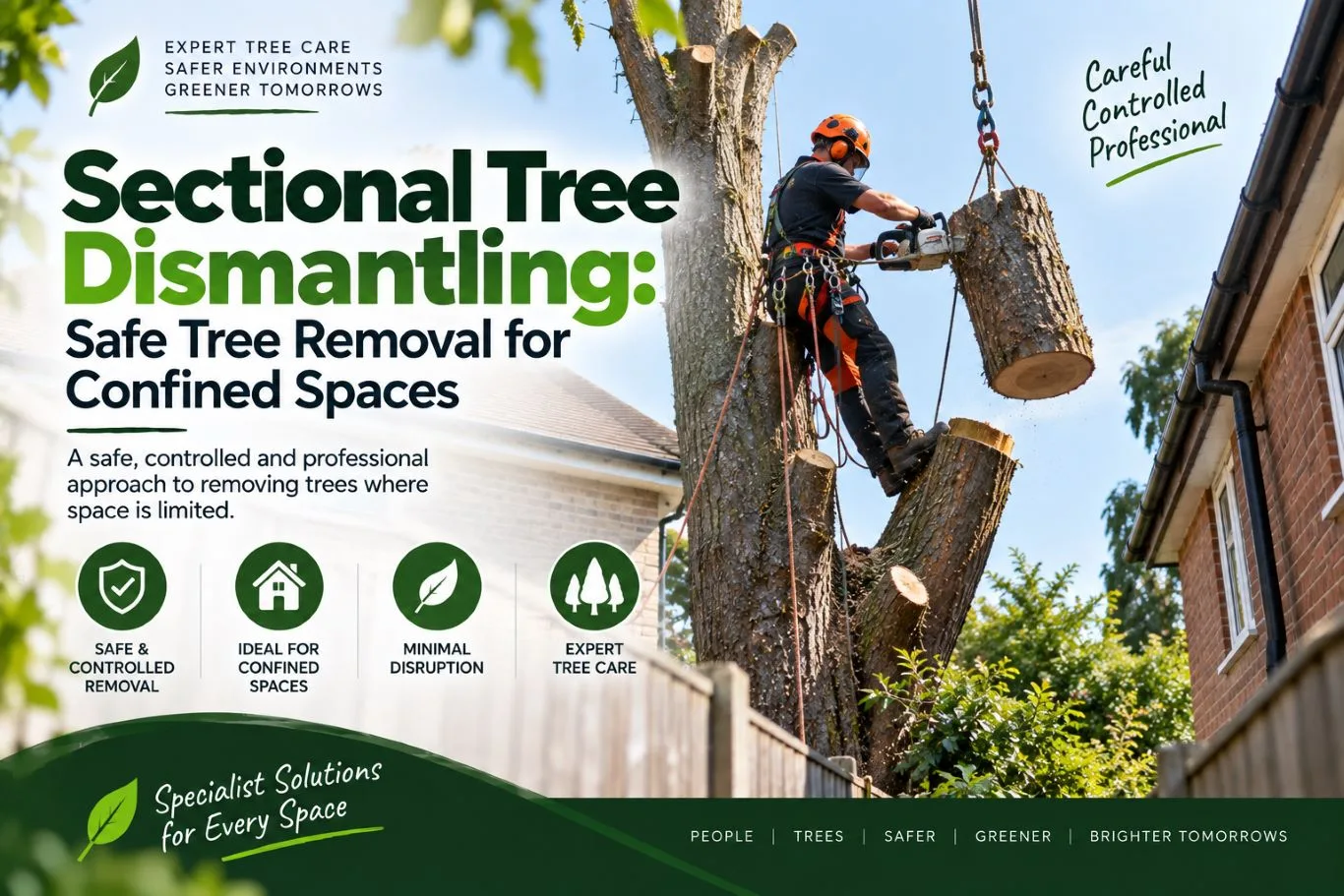
Sectional tree dismantling (frequently termed sectional tree removal or piece-by-piece felling) is the systematic process of cutting down a tree in carefully controlled sections, working from the outer crown inward and from the top down to ground level.
The Rigging & Dismantling Workflow:
- Canopy Access: The lead climber ascends the tree using friction hitches and wire-core flip lines.
- Crown Stripping: Outer lateral branches are removed to balance weight and clear work lines.
- Rigging Hub Setup: Pulleys, heavy-duty slings, and lowering ropes are installed at high anchor points.
- Controlled Lowering: Heavy timber sections are cut using step or notch cuts and lowered under rope brake tension.
- Trunk Sectioning: The bare main stem is cut into manageable “billets” or “chumps” and lowered into the drop zone.
Instead of allowing severed timber to fall freely to the ground, qualified tree surgeons secure each bough with high-strength rigging ropes before a chainsaw ever touches the wood. This approach allows for total control over the speed, trajectory, and landing position of every cut branch.
When Is Tree Dismantling in Confined Spaces Essential?
Carrying out tree dismantling in confined spaces is required when surrounding site conditions eliminate any safe falling radius:
- Proximity to Buildings & Conservatories: When limbs overhang house roofs, guttering, solar panels, or glass conservatories, free-falling debris would cause catastrophic structural damage.
- Tight Property Boundaries: Trees planted along fence lines often share space with neighbours' garages, outbuildings, or expensive brick garden walls.
- Overhead Utility Cables: Phone lines and power cables threaded through the outer canopy require meticulous sectional rigging to avoid service blackouts.
- Restricted Ground Access: In terraced properties or courtyards where the ground zone is limited to a small paved patio or lightwell, tree removal in tight spaces ensures the landing impact does not crack subterranean drainage pipes or stone paving slabs.
- Diseased or Structurally Compromised Wood: Trees suffering from severe trunk cavities or root decay cannot withstand the mechanical shock of directional base felling without tearing or kicking back unpredictably.
The Mechanics of Controlled Tree Dismantling
True controlled tree dismantling is an intricate blend of tree anatomy, physics, and advanced rigging hardware. Arborists do not simply hack away at wood; they calculate timber mass, dynamic shock loads, and drop trajectories at every cut.
| Rigging Component | Technical Function | Garden Protection Benefit |
| Arboricultural Pulleys & Impact Blocks | High-load pulleys mounted at strong anchor points to route lowering ropes. | Eliminates rope friction damage and absorbs dynamic kinetic shock loads. |
| Bollards & Friction Devices | Ground-mounted friction brakes (e.g., Hobbs device or Port-a-Wrap). | Enables a single ground operative to smoothly hold and lower 500kg logs. |
| Taglines & Guiding Ropes | Secondary control lines attached to the tip of a severed limb. | Steers limbs away from walls, windows, and plants while suspended in mid-air. |
| Speedlines & Zip-Lines | Tensioned aerial cables anchored between the tree canopy and a chipper truck. | Transports branches over rooftops and delicate lawns without touching the garden. |
Executing the sectional dismantling of trees requires clear communication between the climbing arborist and the ground crew. The team calculates branch balance points, choosing between tip-tied, butt-tied, or cradle-rigged configurations so that branches lift cleanly away from obstacles before being winched safely downward.
Specialized Challenges: Tree Removal in Confined Spaces
Operating within high-density residential settings demands specialized solutions tailored to site-specific constraints:
1. Working on Unclimbable or Decayed Trees
When a tree is dead, brittle, or unstable, it may not safely support a climber's weight and the dynamic force of lowering ropes. In these instances, arboricultural specialists utilize Mobile Elevating Work Platforms (MEWPs / cherry pickers) with narrow, tracked chassis designed to fit through standard garden side gates. For landlocked plots with zero mechanical access, heavy mobile cranes are brought in to lift huge timber sections straight over the roofline of the house.
2. Manual Timber Extraction Through Narrow Spaces
Once dismantled, heavy hardwood billets and brushwood must be extracted from the garden. Experienced teams use low-ground-pressure turf tires, protective ground mats, and electric timber carts to move debris through narrow side alleys or domestic garages without churning up lawns or scuffing garden walls.
For commercial and residential property managers needing complex extractions, engaging professional tree dismantling services in Essex ensures high-risk projects are carried out without delays or collateral damage.
The Critical Importance of Qualifications and Standards
Undertaking tree dismantling in tight spaces is one of the most hazardous tasks in professional arboriculture. Cutting heavy timber while suspended 60 feet in the air next to residential buildings leaves zero margin for error.
Homeowners must verify that their chosen contractor strictly adheres to established UK industry frameworks:
- British Standard BS 3998:2010 (Tree Work Recommendations): Establishes national standards for pruning, rigging limits, and clean arboricultural cutting practices.
- NPTC / City & Guilds Certifications: Operatives must hold mandatory qualifications in aerial tree climbing (CS38), aerial tree rescue, and aerial tree rigging (CS41).
- Robust Insurance Cover: Professional tree surgery companies must carry comprehensive Public Liability Insurance (minimum £5m to £10m) specifically underwritten for high-risk aerial dismantling and rigging.
- Site-Specific RAMS: Provision of formal Risk Assessments and Method Statements detailing rigging anchor safety, drop zones, and public pedestrian safety.
Hiring unqualified “doorstep handymen” without specialized rigging gear often leads to dropped boughs, cracked roofing tiles, broken boundary fences, and expensive personal liabilities.
FAQs
1. What is the difference between straight tree felling and sectional tree dismantling?
Straight tree felling involves making directional cuts at the base of the tree so the entire trunk drops to the ground in a single controlled motion. This requires a large, clear fall zone. Sectional dismantling takes the tree down in small, manageable pieces from the canopy down using climbing gear and lowering ropes, making it ideal for restricted spaces near homes and outbuildings.
2. Can sectional dismantling damage my garden lawn or patio?
Not when carried out by experienced professionals. Arborists deploy protective ground mats, use specialized friction rigging devices to lower timber to the ground with zero impact shock, and maintain designated landing zones to prevent damage to stone slabs, lawns, or underground utilities.
3. How quickly can your local team arrange an on-site assessment for a confined tree removal?
We maintain a responsive, locally based team. For residential and commercial properties across our primary service territory, we can typically schedule an on-site survey and provide an itemised, fixed-price quote within 24 to 48 hours.
4. What geographical areas do your aerial dismantling teams cover?
Our daily operational footprint spans the whole of Essex—including Chigwell, Loughton, Woodford, Buckhurst Hill, Epping, Brentwood, Romford, and Chelmsford—as well as adjacent East London and North London boroughs.
5. Do you handle planning applications for protected trees in tight spaces?
Yes. If your tree is protected by a Tree Preservation Order (TPO) or is located within a Conservation Area, we manage the entire formal council application and planning liaison on your behalf before commencing dismantling work.
Conclusion / Final Thoughts
Extracting large trees from tight urban gardens and complex commercial boundaries does not have to result in stress, mess, or structural damage. By choosing professional sectional tree dismantling, property owners benefit from an engineered, top-down removal method that controls every piece of timber with surgical precision, protecting roofs, conservatories, and neighbouring properties.
At Chigwell Tree Services, our team brings certified arboricultural qualifications, advanced rigging equipment, and comprehensive insurance cover to every challenging removal we undertake. We work closely with homeowners, commercial facilities managers, and local authorities to deliver transparent, reliable, and completely safe tree extractions across the region. Whether you are dealing with a dead tree leaning over your garage or an overgrown hardwood threatening your conservatory, our qualified climbers are ready to help. Secure your property and remove problematic timber safely today—reach out to our friendly local specialists to book your free, no-obligation site consultation.
Facing an awkward, overgrown, or dangerous tree wedged in a tight garden space? Secure your bespoke, competitive quote from our certified dismantling specialists across Essex, East London, and North London today :