Quick Summary
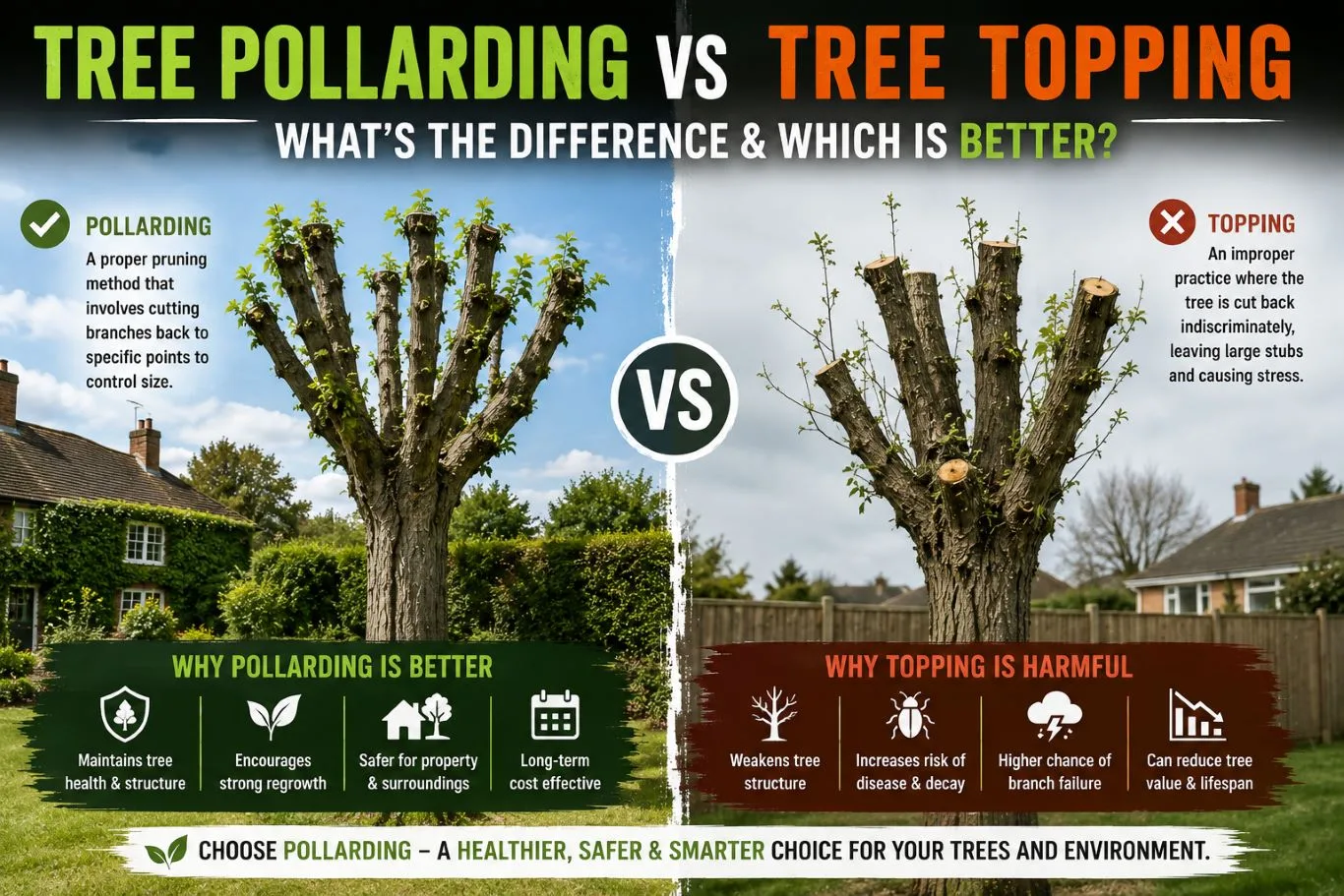
- Comparing tree pollarding vs tree topping highlights the vital difference between an ancient, biologically sound pruning framework and a damaging, indiscriminate cutting practice.
- Tree pollarding involves systematically cutting upper branches back to designated “pollard heads” on young trees, encouraging strong, controlled regrowth and long-term structural stability.
- Tree topping lopped mature stems back to arbitrary stubs, shocking the plant's vascular system and inviting severe internal wood rot.
- Discover why professional pollarding offers clear economic and safety advantages for managing urban and roadside boundary boundaries.
- Learn about real-world applications of structural pollarding that maintain property safety without compromising landscape aesthetics.
Introduction
Managing large, fast-growing trees in residential gardens or along public highways requires balancing natural growth with surrounding infrastructure. When a canopy begins to shade windows, interfere with overhead cables, or crowd neighbouring properties, controlling its height becomes essential. However, the technique chosen to manage that height determines whether the tree remains a safe asset or becomes a costly liability. Property owners comparing tree pollarding vs tree topping often assume both methods simply achieve a smaller tree. In reality, one is a traditional, highly controlled pruning regime that preserves health and structural stability, while the other is an abusive practice that damages trees from the inside out. At Chigwell Tree Services, we bring extensive industry experience and certified standards to every project, offering trusted tree services in Essex to ensure your landscape remains safe, healthy, and beautifully proportioned.
Ready to reduce canopy height safely while maintaining your tree’s natural shape and health? Message our friendly Essex specialists on WhatsApp now :
The Core Definitions: Understanding the Frameworks
To evaluate pollarding vs topping, it is important to examine the biological mechanism behind each practice:
Methodology Overview:
– Tree Pollarding: Started on young trees, cuts back to swelling “pollard heads,” creates strong union sockets, repeated cyclic cuts.
– Tree Topping: Applied to mature trees, leaves blunt open stubs, destroys main leader, triggers weak bark-attached sprouts.
What Is Tree Pollarding?
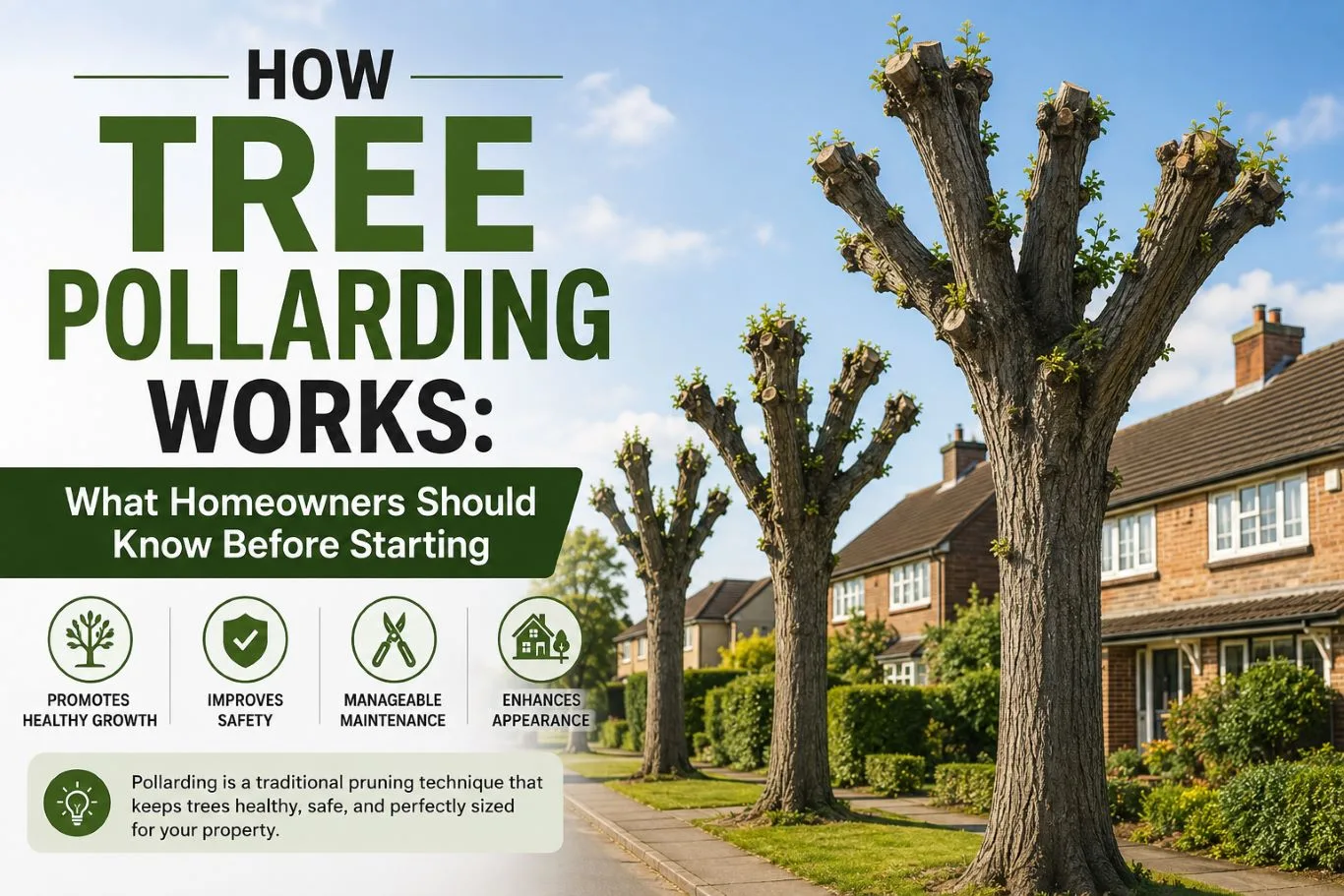
Pollarding is an established arboricultural management system dating back centuries. It involves removing the upper branches of a young, vigorous tree once it reaches a predetermined height.
Crucially, this process is repeated on a regular cycle (typically every 1 to 3 years). Over time, swelling knobs of calloused wood known as “pollard knuckles” or “heads” form at the cut ends. These specialized points store vital carbohydrates and contain dense dormant buds that produce uniform, upright shoots each spring. Because the cuts are made to these established sockets, the tree seals off wounds effortlessly, maintaining strong structural attachments.
What Is Tree Topping?
Tree topping is an indiscriminate, destructive practice where a mature tree's central leader and major structural limbs are cut straight across at arbitrary heights.
Instead of cutting to a natural lateral branch or an established pollard head, topping leaves large, flat, open stubs. This severe removal of foliage shocks the tree's vascular system, leaving large open wounds exposed to rain, fungal spores, and boring pests.
Why Tree Topping Harms Trees
Understanding why tree topping is bad requires looking at the biological stress it places on a mature plant:
- Severe Vascular Shock and Starvation: Leaves are the photosynthetic engines of a tree. Topping strips away the majority of the leaf-bearing crown in one swift blow, instantly starving the root system of vital starches.
- Weak Epicormic Regrowth: In a desperate attempt to survive, the tree uses up its emergency energy reserves to push out dense clusters of shoots called epicormic sprouts. These shoots grow rapidly but are anchored only to the thin outer bark layer rather than deep within the wood tissue, making them prone to snapping during high winds.
- Internal Decay and Wood Rot: Large, flat topping cuts on mature limbs cannot form calloused wood over the open wound. Water settles on top of these stubs, inviting wood-rotting fungi to travel down into the main trunk core.
- Diminished Landscape Value: Topping permanently ruins the natural architecture of a tree, leaving behind an unsightly collection of bare stumps that lowers property curb appeal.
The Advantages: Benefits of Tree Pollarding
When executed correctly by trained professionals, tree pollarding services offer numerous structural, environmental, and practical advantages:
- Controlled Canopy Dimensions: Pollarding allows large species like London Plane, Lime, and Willow to be grown safely in tight urban spaces, narrow gardens, or near building foundations.
- Long-Term Cost Efficiency: Once a pollard framework is established, maintaining it on a 2- to 3-year cycle is straightforward, predictable, and cost-effective compared to handling large, unpredictable canopy reductions.
- Enhanced Safety Around Boundaries: By keeping branches short and light, pollarding eliminates the risk of heavy deadwood forming over footpaths, parked vehicles, or rooflines.
- Extended Life Expectancy: Regular pollarding reduces wind resistance and top-heavy weight, allowing trees to survive severe gales that might uproot un-managed specimens.
Real-World Case Study: Roadside Pollarding in Aldersbrook
The practical value of professional pollarding is best demonstrated through real-world urban tree management. Managing roadside trees requires striking the right balance between public safety, tree health, and long-term maintenance.
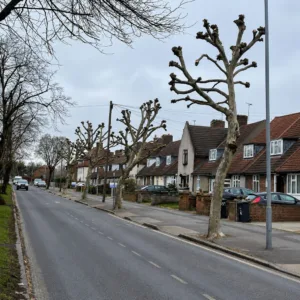
Our team at Chigwell Tree Services recently completed a major roadside tree pollarding project in Aldersbrook, London. The goal was to carefully reduce the crowns of mature highway trees while maintaining the natural structural framework of each specimen.
Executed using safe traffic management protocols, professional climbing equipment, and a thorough site clean-up throughout, the project highlighted how cyclic pollarding controls future growth, removes potentially hazardous overhanging limbs, and keeps public thoroughfares safe for pedestrians and motorists alike. Whether serving local authorities, commercial estates, or private properties in Aldersbrook, Wanstead, Leytonstone, Stratford, Leyton, or the surrounding East London and Essex areas, professional pollarding remains the gold standard for highway canopy care.
Why Professional Execution Matters
Attempting to pollard an older, un-managed tree that has never undergone early structural pruning is a common mistake. Converting a mature, un-pollarded tree into a pollard late in life is essentially topping, and carries all the associated decay risks.
Consulting affordable tree surgeons in Essex ensures your landscape receives an accurate assessment. Qualified arborists evaluate species suitability—such as Lime (Tilia), Plane (Platanus), Willow (Salix), and Ash (Fraxinus)—and execute precise target cuts that comply strictly with British Standard BS 3998:2010 regulations. Engaging professional tree surgery specialists ensures your property remains safe, attractive, and compliant with local conservation rules.
FAQs
1. Which tree species are best suited for pollarding?
Species with strong sprouting capability excel under pollarding. Broadleaf trees like London Plane, Lime, Willow, Poplar, and Hornbeam respond exceptionally well. Conifers and evergreens should generally never be pollarded, as they lack the dormant bud structures required to sprout from old wood.
2. Can an old, topped tree be saved and converted into a healthy pollard?
It is difficult, but possible through corrective management. A qualified arborist can perform selective thinning over several seasons, choosing the strongest regrowth shoots to form new pollard heads while managing decay in the old stubs.
3. How quickly can your field specialists visit my property for a consultation?
We maintain a prompt local scheduling network. For standard domestic and commercial care evaluations, we can typically arrange an on-site site visit within 24 to 48 hours of your inquiry.
4. What specific geographical areas do your local teams cover?
Our daily operational area fully encompasses the entire county of Essex, including Chigwell, Loughton, Epping, Woodford, Brentwood, Buckhurst Hill, as well as adjacent East and North London districts.
5. Are your tree management operations fully qualified and insured?
Yes, completely. Our entire field crew holds fully verified NPTC and LANTRA qualifications for operating commercial arboricultural machinery and climbing equipment. We carry extensive public liability insurance, ensuring all tree work is completed safely and in accordance with strict industry standards.
Conclusion / Final Thoughts
Comparing tree pollarding vs tree topping leaves no doubt about which method protects your landscape investment. While tree topping mutilates branches, triggers hazardous regrowth, and invites internal trunk rot, professional pollarding offers a proven, traditional framework for managing tree size safely and sustainably. Choosing certified arboricultural techniques keeps your grounds secure, protects nearby infrastructure, and preserves your trees for generations to come.
At Chigwell Tree Services, we take pride in delivering honest, professional, and customer-focused care for domestic gardens, commercial properties, and public spaces alike. We combine modern machinery with certified arboricultural techniques to deliver clean, efficient, and precise results. If you are looking for trusted tree services in Essex or need an authoritative evaluation for an overgrown roadside canopy, our local specialists are always ready to assist. Restore your garden's true potential today by choosing a professional, authoritative standard of care for your grounds.
Looking to get expert tree pollarding services in Essex?