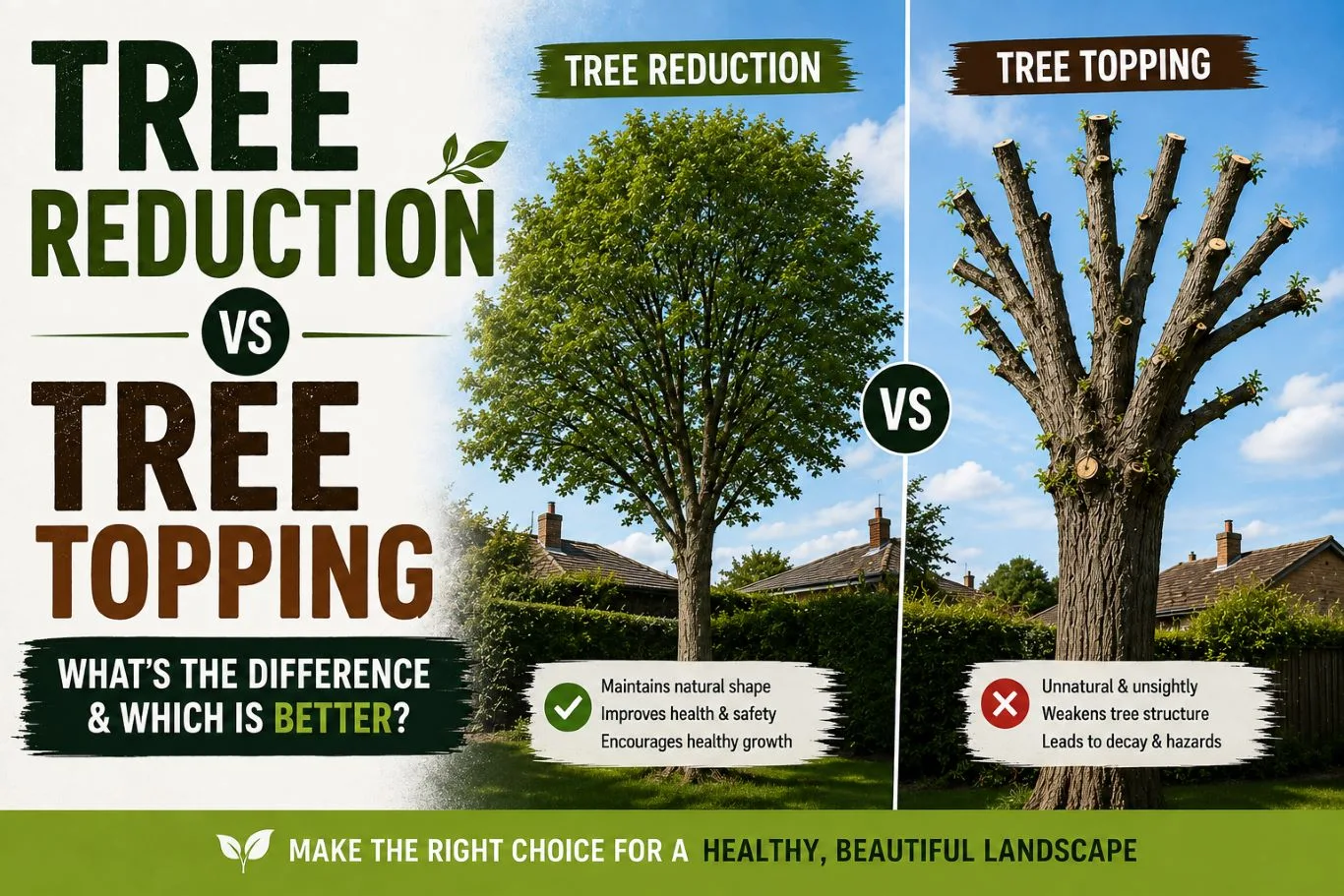
Quick Summary
- Comparing tree reduction vs tree topping reveals two completely different approaches to managing overgrown or tall garden trees.
- Tree reduction is a skilled arboricultural practice that scales down a canopy while preserving its structural framework and natural shape.
- Tree topping is a harmful, indiscriminate technique that lops off major vertical stems, leaving unsightly stubs that trigger decay and weak regrowth.
- Discover why professional crown reduction improves tree safety, allows natural light into your garden, and encourages healthy, balanced growth.
- Learn how correct pruning techniques protect your property investments and prevent long-term hazard creation.
Introduction
When a mature tree in your garden begins to block sunlight, encroach on telephone wires, or simply looms too large over your roofline, taking steps to manage its size becomes a priority. However, the way a tree is pruned determines whether it will continue to thrive for decades or suffer a rapid, costly decline. Many property owners ask about the difference between tree reduction vs tree topping when trying to bring a large canopy under control. While both methods reduce a tree’s height, the biological impact, visual finish, and long-term safety results are fundamentally opposite. At Chigwell Tree Services, we specialize in professional arboriculture, delivering high-quality, biologically sound tree services in Essex to ensure your trees remain healthy, structurally stable, and beautiful through every season.
Ready to reduce canopy height safely while maintaining your tree’s natural shape and health? Message our friendly Essex specialists on WhatsApp now :
Understanding the Difference: Reduction vs Topping
To make an informed decision for your garden, it helps to understand what happens to a tree under each pruning method.
Core Pruning Comparison:
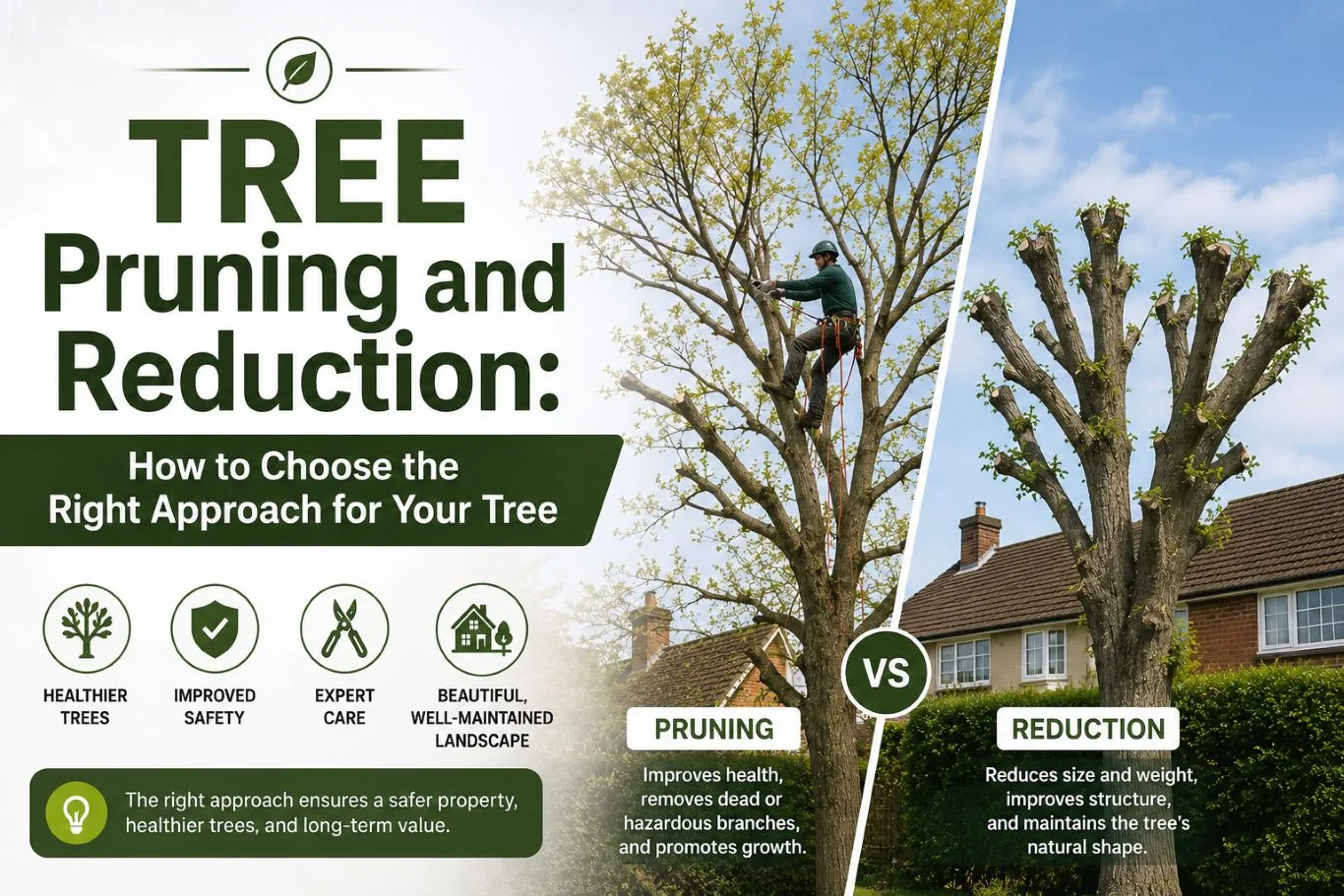
– Crown Reduction: Selective target cuts, respects branch collars, maintains natural framework, leaves healthy growth.
– Tree Topping: Indiscriminate lopping, leaves blunt stubs, destroys canopy shape, triggers weak epicormic sprouts.
What Is Crown Reduction?
Crown reduction (often referred to as drop-crotch pruning) is a precise, recognized arboricultural technique. During a crown reduction, an arborist selectively shortens the outer framework of the canopy by cutting branches back to suitable lateral side branches (lateral leaders). These remaining lateral branches must be large enough—typically at least one-third the diameter of the stem being removed—to assume the dominant role and draw sap up through the limb.
Because the cuts are executed just outside the natural branch collars, the tree can seal its wounds effectively. The result is a tree that is visibly smaller and safer, yet retains its natural, balanced silhouette.
What Is Tree Topping?
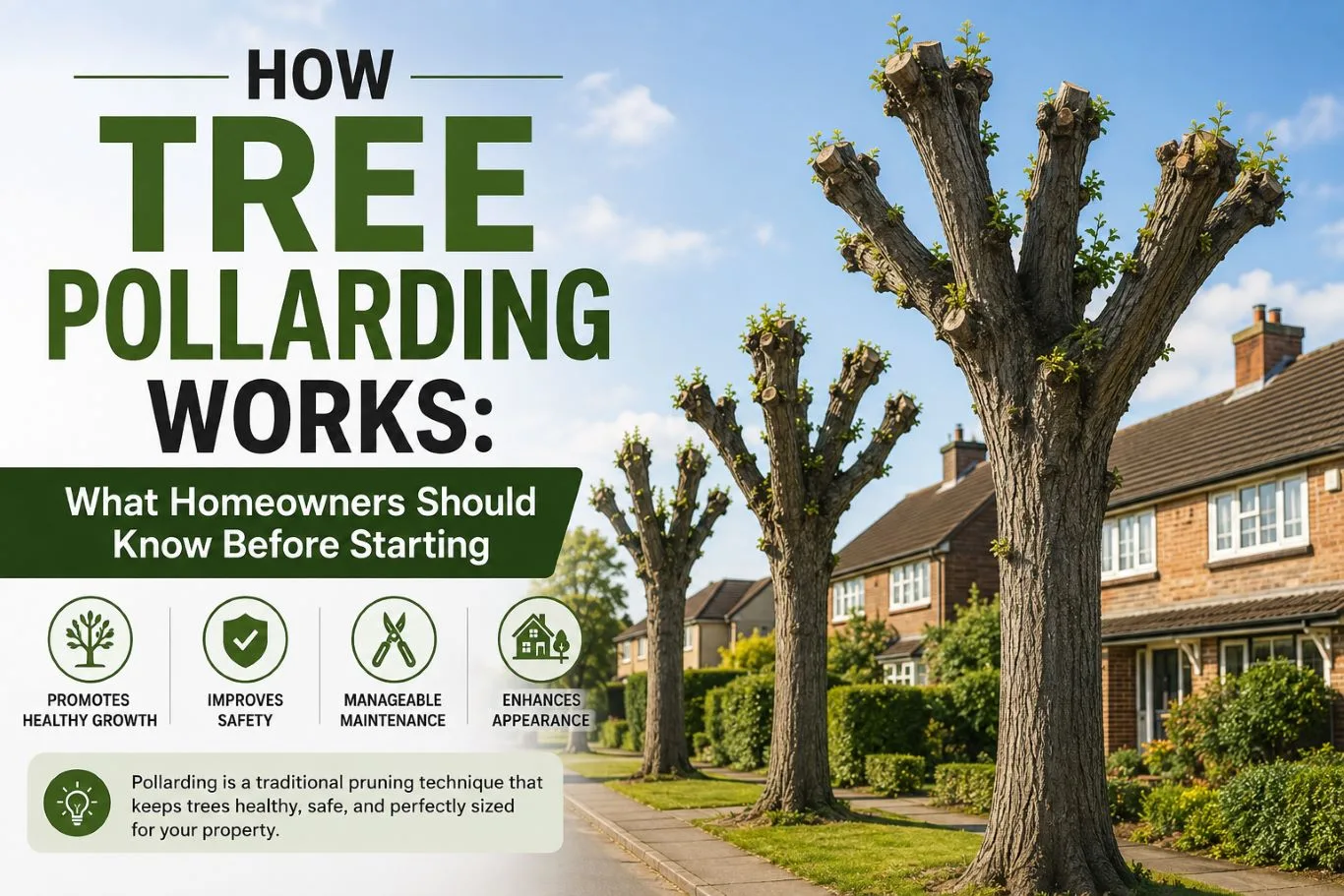
Tree topping (sometimes called lopping, stubbing, or heading) is an indiscriminate, outdated practice. It involves cutting mature vertical stems and primary scaffold branches straight across at an arbitrary height, leaving blunt, leafless stubs sticking up into the air.
Topping completely strips away the upper leaf structure, shocking the plant's vascular system. Rather than managing growth, topping triggers a panic response in the tree, leaving an ugly, mutilated framework that invites pests and structural decay.
Why Tree Reduction Is Better Than Tree Topping
Comparing the two methods clearly shows that crown reduction is superior for maintaining tree health, safety, and property value. Topping inflicts severe damage that creates ongoing maintenance costs and safety hazards.
1. Preserving Natural Aesthetics vs Ugly Mutilation
- Crown Reduction: Retains the natural aesthetic curve and flowing canopy of the species. The tree simply looks like a smaller, well-proportioned version of itself, enhancing your garden’s overall appearance.
- Tree Topping: Leaves an unnatural, unsightly collection of bare stumps. The architectural beauty of the tree is permanently destroyed, often diminishing the curb appeal of your property.
2. Promoting Healthy Growth vs Starvation and Shock
- Crown Reduction: Retains enough active foliage so the tree can continue photosynthesizing normally. The balanced removal of wood allows light to reach inner branches without starving the root system.
- Tree Topping: Strips away up to 50% to 100% of the leaf-bearing crown. Leaves are the tree’s food factories; without them, the tree undergoes severe stress, consuming stored root starches just to stay alive and leaving it highly vulnerable to disease.
3. Structural Stability vs Weak, Hazardous Regrowth
- Crown Reduction: Encourages solid, healthy wood development along established lateral branches, ensuring the canopy can withstand strong gales and summer storms.
- Tree Topping: Triggers a dense, bushy explosion of weakly attached shoots called epicormic sprouts around the cut stubs. These fast-growing shoots are anchored only to the outer bark layer rather than deep within the wood tissue. As they grow heavy, they snap off easily during high winds, creating a far greater falling hazard than the original canopy.
4. Natural Disease Sealing vs Deep Internal Decay
- Crown Reduction: Precise target cuts made at branch collars allow the tree to naturally wall off wounds through compartmentalization, preventing fungal spores from reaching the main trunk.
- Tree Topping: Blunt, flat cuts on large stubs cannot heal over. Water sits on top of these exposed wounds, creating ideal conditions for wood-rotting fungi and boring insects to penetrate deep into the heartwood, rotting the tree from the inside out.
The Hidden Financial Cost of Tree Topping
Property owners are sometimes tempted by topping because it appears to offer a quick, cheap fix for an overgrown tree. However, topping is far more expensive over time:
- Increased Pruning Frequency: Because topping triggers rapid panic growth, the tree quickly produces a jungle of weak shoots that must be trimmed back every year or two.
- Emergency Removal Costs: As internal rot hollows out topped stubs, the tree becomes structurally unstable. Eventually, the entire tree must be taken down to prevent it from falling on nearby homes or boundary walls.
- Property Value Impact: Mutilated, decaying trees lower property appeal and can be flagged as hazards during structural home surveys.
Investing in professional crown reduction avoids these ongoing costs, protecting both your trees and your property investment.
Working with Qualified Arborists
Executing a proper crown reduction requires specialized climbing equipment, rigging tools, and a clear understanding of tree biology. Making cuts at height while preserving the natural balance of a canopy is skilled work that should never be left to untrained handymen.
When searching for affordable tree surgeons in Essex, it is essential to choose a team that adheres strictly to British Standard BS 3998:2010 (Recommendations for Tree Work). Professional tree surgeons will never recommend topping a mature tree. Instead, they will assess the species, evaluate canopy density, and calculate the correct percentage of reduction required to achieve your goals safely.
FAQs
1. Can a topped tree ever fully recover its natural shape?
Recovery from topping is very difficult and requires years of careful management. A qualified arborist can perform selective corrective pruning over several seasons, removing weak epicormic shoots and training the strongest remaining branch to become a new main leader.
2. What is the maximum percentage a tree crown should be reduced?
In accordance with British Standard BS 3998, a crown reduction should generally not remove more than 20% to 30% of a tree’s total leaf volume in a single operation. Removing more foliage starves the root system and causes severe stress.
3. How quickly can your field crews visit my property for a consultation?
We operate an efficient local scheduling service. For domestic and commercial tree assessments, we can typically schedule an on-site visit within 24 to 48 hours of your initial inquiry.
4. What specific geographical areas do your local teams cover?
Our daily operational area spans the whole of Essex, including Chigwell, Loughton, Epping, Woodford, Brentwood, Buckhurst Hill, and surrounding North London borders. This local presence ensures prompt response times and familiarity with regional soil types and council conservation rules.
5. Are your tree reduction operations fully qualified and insured?
Yes, completely. Our entire field crew holds fully verified NPTC and LANTRA arboricultural qualifications. We carry extensive public liability insurance, ensuring all crown reduction work is completed safely, cleanly, and in accordance with strict industry standards.
Conclusion / Final Thoughts
Understanding tree reduction vs tree topping makes it easy to choose the right approach for your landscape. While tree topping destroys natural canopy structure, triggers weak regrowth, and leads to internal decay, professional crown reduction scales down height safely while improving health, stability, and aesthetics. Choosing proper arboricultural pruning protects your home from storm hazards and keeps your trees looking beautiful for decades to come.
At Chigwell Tree Services, we deliver clean, reliable, and professional care for domestic gardens and commercial estates alike. We pair advanced climbing equipment with certified techniques to ensure every cut supports long-term tree health. If you require trusted tree services in Essex or need an expert evaluation for an overgrown canopy, our local team is always ready to assist. Keep your landscape safe and thriving by choosing a professional, authoritative standard of care for your grounds.
Looking to get expert tree reduction services in Essex?