Quick Summary
- Identifying the best trees for pollarding ensures your garden features species capable of vigorous regrowth and rapid wound healing.
- Learn why broadleaf species like London Plane, Lime, Willow, and Ash respond exceptionally well to cyclical pollard regimes.
- Discover why conifers and resinous evergreens should almost never be pollarded due to their lack of dormant bud structures on old wood.
- Understand key timing considerations, seasonal cycles, and biological mechanisms that make pollarding an effective urban management tool.
- Find out how professional arborists evaluate tree age, vigor, and structural framework before establishing new pollard heads.
Introduction
Managing large, vigorous trees within British gardens, suburban avenues, and commercial landscapes requires balancing natural growth with surrounding infrastructure. When a tree threatens to block natural light, encroach on overhead power lines, or crowd property boundaries, controlling its canopy spread becomes an essential maintenance goal. Pollarding—a traditional pruning system where upper branches are cut back to a main trunk or central framework—is one of the most effective methods for restricting tree size without causing biological collapse. However, not all tree species can tolerate such intensive pruning. Choosing from the best trees for pollarding is crucial for ensuring the specimen seals wounds quickly, produces strong annual shoots, and maintains long-term structural stability. At Chigwell Tree Services, our certified arborists deliver expert guidance and professional tree pollarding services in Essex, helping property owners manage tree height safely and sustainably.
Protect your property boundaries and maintain your trees' long-term vitality; click below to discuss tailored pollarding directly with Chigwell Tree Services :
What Makes a Tree Suitable for Pollarding?
Pollarding is a specialized pruning technique that relies on a tree's natural physiological ability to sprout fresh shoots from dormant buds beneath the bark. When you cut back a branch on a pollarding-tolerant species, the plant responds by forming calloused tissue—often called a “pollard head” or “knuckle”—which stores energy reserves and produces dense, upright stems each growing season.
Key Biological Traits of Pollard-Tolerant Species
- Strong Epicormic Sprouting: The ability to produce vigorous shoots (epicormic growth) from old wood after major stem pruning.
- Rapid Wound Compartmentalization: High levels of natural chemical barriers that seal off exposed wood and prevent fungal decay from traveling down into the central trunk.
- Resilience to Cyclical Pruning: The ability to endure repetitive cutting every 1 to 3 years without going into vascular shock or suffering root dieback.
The Best Trees for Pollarding in the UK
Broadleaf deciduous trees dominate the list of species best suited for this traditional pruning method. Below are the top tree species in the UK that respond exceptionally well to pollarding:
1. London Plane (Platanus × hispanica)
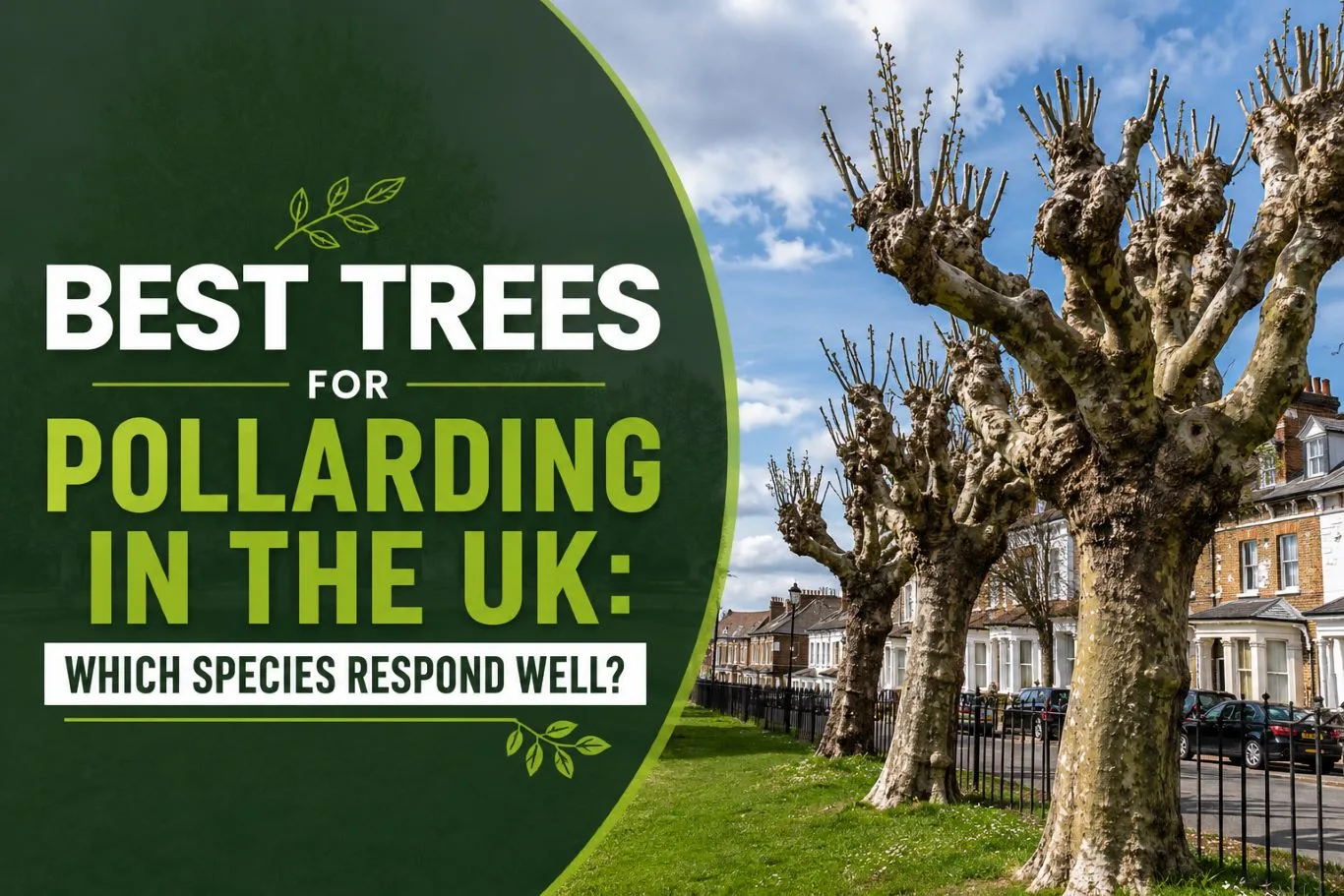
The London Plane is perhaps the most famous pollarded tree across UK towns and cities. Known for its incredible tolerance to urban air pollution and soil compaction, it reacts to pollarding by forming massive, distinctive pollard heads.
- Why it works: London Planes compartmentalize decay rapidly and sprout vigorously, making them ideal for narrow urban streets, avenues, and small civic parks.
- Pollarding Cycle: Every 1 to 3 years during dormant winter months.
2. Common Lime (Tilia × europaea) & Broad-Leaved Lime (Tilia platyphyllos)
Lime trees are classic candidates for street and garden pollarding across Britain. Left unmanaged, Limes grow into massive, dense trees that cast heavy shade and drop sticky honeydew.
- Why it works: Lime wood responds with prolific shoot growth, producing uniform, leafy screens that block sightlines or shade without extending past boundary walls.
- Pollarding Cycle: Every 1 to 2 years to control dense sucker growth around pollard knuckles.
3. Willow Species (Salix spp.)
Willows—including Crack Willow, White Willow, and Weeping Willow—have an unmatched capacity for rapid regrowth. Historically, pollarded willows along riverbanks supplied osiers (flexible stems) for basket weaving and hurdle fencing.
- Why it works: Willows sprout instantly from aggressive cuts, making them ideal for damp soils, riverbanks, and countryside boundaries where size control is necessary.
- Pollarding Cycle: Annual or bi-annual pruning during late winter.
4. Ash (Fraxinus excelsior)
Common Ash has a long history of agricultural pollarding across the UK landscape, used traditionally to produce firewood and tool handles out of reach of grazing livestock.
- Why it works: Ash trees form strong, upright poles from pollard knuckles and seal cut surfaces effectively when healthy.
- Note on Health: Ash trees selected for pollarding must be inspected for Ash Dieback (Hymenoscyphus fraxineus) before work begins, as diseased trees cannot tolerate heavy pruning.
5. Hornbeam (Carpinus betulus) & Beech (Fagus sylvatica)
Native Hornbeam and Beech trees take exceptionally well to early pollarding, producing dense, leafy growth that retains crisp brown leaves through much of the winter when managed regularly.
- Why it works: Excellent for establishing formal garden architecture, pleached hedging, and compact boundary screens in domestic gardens.
- Pollarding Cycle: Every 2 to 3 years.
6. Poplar (Populus spp.) & Alder (Alnus glutinosa)
Fast-growing species like Black Poplar, Lombardy Poplar, and Common Alder respond aggressively to pollarding, making them suitable for windbreaks and wet ground management.
- Why it works: Pollarding prevents tall Poplars from becoming top-heavy or prone to limb failure during heavy gales.
Species You Should NEVER Pollard
While broadleaf deciduous trees thrive under this regime, certain trees suffer irreversible damage if pollarded:
Pruning Compatibility Warning:
– DO POLLARD: London Plane, Lime, Willow, Ash, Hornbeam, Beech, Poplar, Alder, Mulberry, Eucalyptus.
– DO NOT POLLARD: Conifers (Leighton Cypress, Leylandii, Pine, Fir, Spruce) & Resinous Evergreens.
Why Conifers Fail Under Pollarding
With the exception of Yew (Taxus baccata) and Larch (Larix deciduas), conifers do not possess dormant buds on old, brown wood. If you cut a Leylandii, Pine, or Spruce back to bare wood, it cannot produce new green shoots. The exposed timber simply dies back, leaving permanent, unsightly brown holes and inviting wood-rotting decay into the main trunk.
Timing and Cost Considerations
Establishing and maintaining a pollard framework is a long-term commitment that requires proper timing and budget planning:
Best Time of Year to Pollard
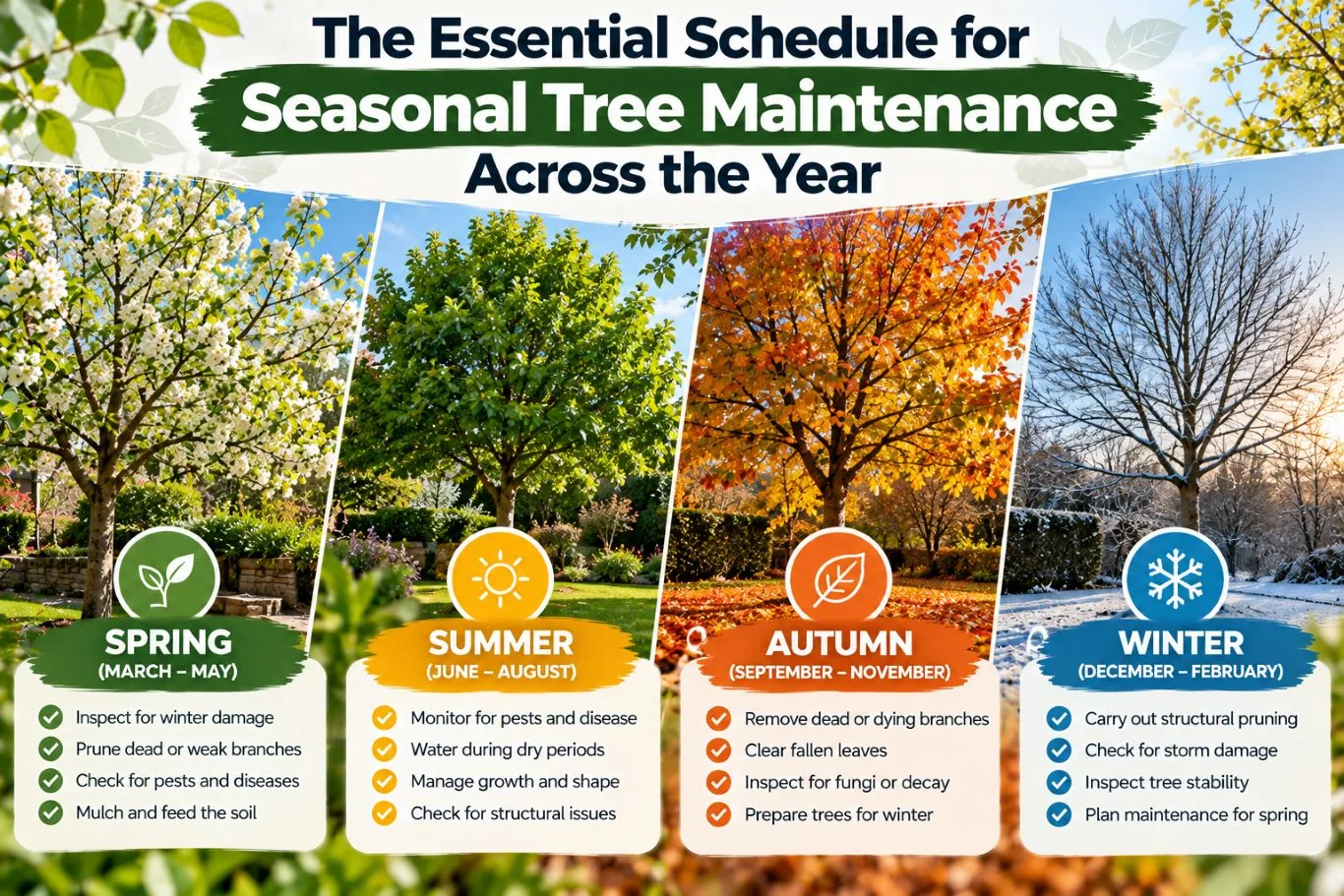
The ideal window for pollarding most UK species is late winter to early spring (January to March) while the tree is dormant and before sap starts rising. Pruning during dormancy minimizes sap loss, prevents vascular shock, and allows wounds to begin sealing immediately as spring growth begins.
Understanding Maintenance Costs
Property owners often ask about ongoing maintenance pricing. In the UK, the average tree pollarding cost UK homeowners pay generally ranges between £200 and £800+ per tree, depending on tree height, accessibility, and whether the work involves re-pollarding established knuckles or establishing a new framework on a young tree. Regular cyclic maintenance is typically much cheaper than managing an overgrown, neglected canopy.
Working with Professional Arborists
Attempting to pollard a mature tree that has never undergone early structural training is a critical mistake. Converting an old, un-managed mature tree into a pollard late in life is essentially “tree topping,” which leaves large, open stubs that rot internally.
Consulting certified local professionals ensures that your trees are evaluated for species suitability, age, and biological vigor before any cuts are made. Professional arborists use specialized climbing equipment, sharp sanitized tools, and precise target cutting techniques that conform strictly to British Standard BS 3998:2010 regulations.
FAQs
1. Can you start pollarding a mature, fully grown tree?
No, pollarding should ideally be initiated when a tree is young and flexible. Cutting back major scaffold limbs on a mature tree that has never been pollarded creates large open wounds that cannot heal, leading to severe decay, structural weakness, and dangerous sprout growth.
2. How often does a pollarded tree need to be cut back?
Once a pollard framework is established, regrowth should be removed on a regular cycle—typically every 1 to 3 years, depending on the species and how compact you wish to keep the canopy.
3. How quickly can your local team visit my property for a pollarding assessment?
We operate a prompt local scheduling network. For domestic and commercial property evaluations, we can typically arrange an on-site visit and provide a detailed quote within 24 to 48 hours of your inquiry.
4. What specific geographical areas do your local arborists cover?
Our daily operational coverage encompasses the entire county of Essex, including Chigwell, Loughton, Epping, Woodford, Brentwood, Buckhurst Hill, as well as surrounding East and North London borders.
5. Are your tree surgeons fully insured and qualified?
Yes, completely. Our entire team holds fully verified NPTC and LANTRA qualifications for commercial tree surgery and climbing operations. We carry comprehensive public liability insurance, ensuring all work is carried out safely and cleanly.
Conclusion / Final Thoughts
Selecting from the best trees for pollarding is the foundation of successful, long-term canopy management. Broadleaf species like London Plane, Lime, Willow, and Hornbeam excel under cyclical pruning, allowing property owners to maintain compact, safe, and visually striking trees near buildings and boundaries. Avoid cutting conifers back to bare wood, and always establish pollard frameworks on young, vigorous trees to prevent internal rot.
At Chigwell Tree Services, we bring years of practical experience, modern machinery, and certified standards to every property we care for. Whether you need to maintain an established avenue of pollards or require professional tree pollarding services in Essex for a private garden, our local specialists are always ready to assist. Keep your trees healthy, safe, and perfectly proportioned by choosing an authoritative standard of care for your grounds.
Tired of dark, overgrown canopies blocking your light or encroaching on boundary lines? Restore space and safety to your garden with expert tree pollarding across Essex :