Quick Summary
- Comparing hedge removal vs hedge reduction enables property owners to make the right financial and practical choice for overgrown boundaries.
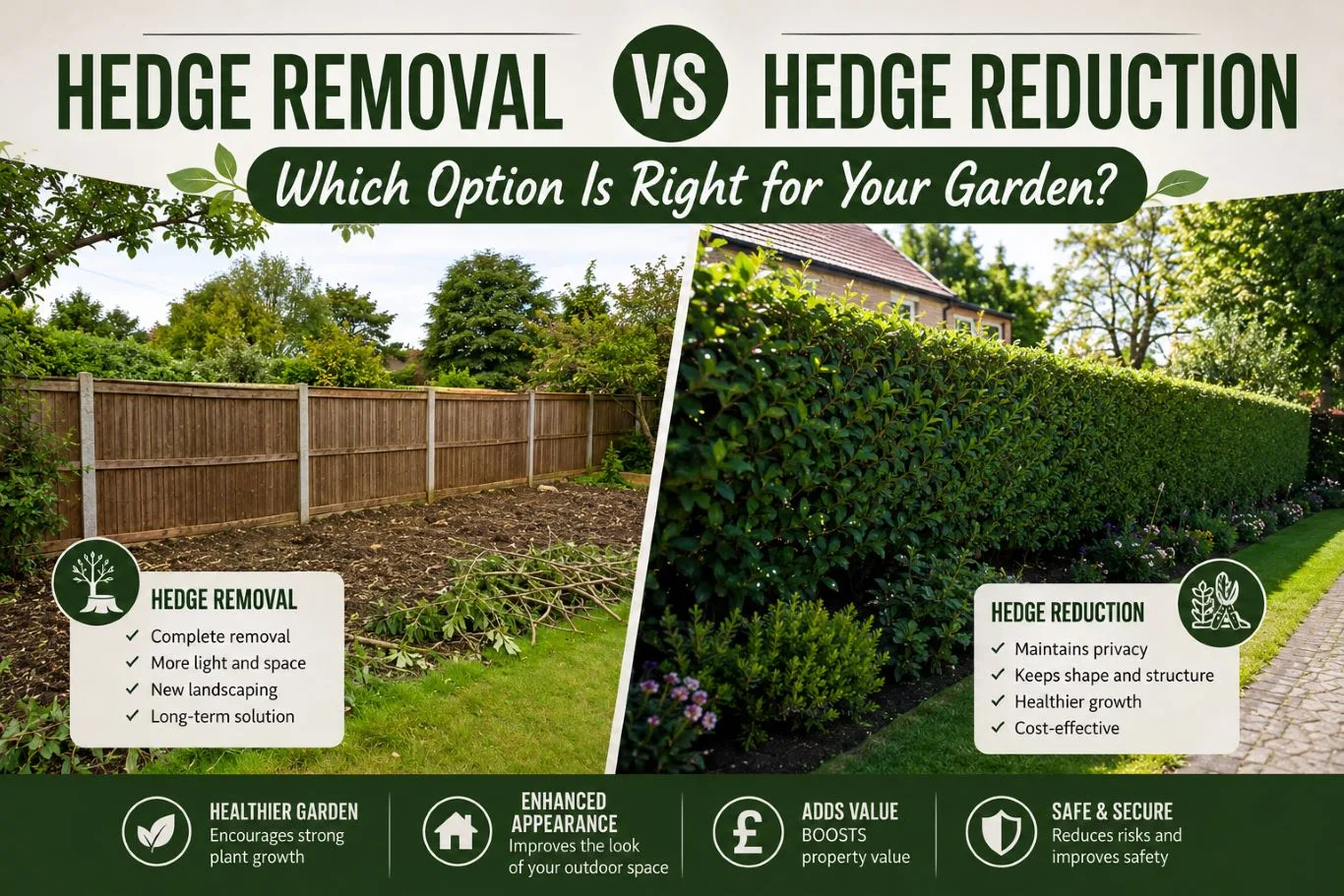
- Hedge Removal extracts the entire hedge along with its root system, completely clearing the ground for new fencing or garden landscaping.
- Hedge Reduction cuts back excessive height and width, rejuvenating overgrown shrubs while maintaining natural privacy, shape, and structure.
- Learn how species tolerance determines whether hard renovation pruning will succeed or cause permanent brown patches (especially with Leylandii conifers).
- Understand UK wildlife legislation, bird nesting season rules, boundary ownership, and the High Hedges Act.
Introduction
A well-maintained boundary hedge offers natural privacy, wind protection, and year-round shelter for local wildlife. However, when fast-growing shrubs or dense conifer rows are left unmanaged, they can quickly block sunlight, encroach on lawn space, and spark boundary disputes with neighbours. When deciding how to restore order to an unruly boundary, property owners must evaluate hedge removal vs hedge reduction. While full extraction clears space entirely for modern fencing or fresh planting, hard reduction reclaims an overgrown hedge without sacrificing privacy. Selecting the right approach depends on your long-term landscape plans, the plant species, and the physical condition of the root network. At Chigwell Tree Services, our certified specialists deliver dependable, affordable, and expert tree services for residential & commercial properties across Essex and nearby areas, ensuring your garden boundaries remain neat, secure, and visually appealing.
Unsure whether your overgrown boundary needs complete removal or a hard height reduction? Chat with Chigwell Tree Services on WhatsApp for expert hedge advice across Essex :
Understanding Hedge Removal
Hedge removal is a complete extraction process that permanently removes the vegetation and root ball from your property boundary.
Operational Process for Hedge Removal:
– Top-Down Dismantling: Stems and upper growth are cut down to ground level using chainsaws and brushcutters.
– Root Extraction: Root balls are mechanically ground out with stump grinders or excavated with mini-diggers.
– Site Clearance: Green waste and roots are processed through commercial chippers and removed.
– Ground Reinstatement: The soil trench is backfilled, leveled, and prepared for new fencing or landscaping.
When Is Complete Removal the Best Choice?
Opting for hedge removal services is recommended under several common garden scenarios:
- Unrecoverable Conifers (Leylandii & Cypress): Most conifers cannot produce new green growth from old brown wood. If a Leylandii hedge has grown excessively wide into your lawn, reducing it back to the boundary line will expose dead wood that will never recover. Complete overgrown hedge removal is often the only realistic remedy.
- Replacing with Modern Fencing: Homeowners seeking to regain garden width often remove wide hedges in favor of slim closeboard fence panels or decorative trellises.
- Severe Disease or Decay: If your hedge suffers from incurable root rot (such as Phytophthora or Honey Fungus) or severe pest infestations (such as Box blight), full extraction prevents the spread of pathogens to neighboring plants.
- Major Garden Redesign: Laying new driveways, building home extensions, or creating open-plan patios often requires clearing old root zones completely.
Understanding Hedge Reduction
Hedge reduction (also known as hard renovation pruning) is an intensive pruning method designed to significantly decrease the overall height and width of an established hedge while keeping the root system and main stems alive.
The Mechanics of Hard Reduction
Unlike regular seasonal hedge trimming or light surface hedge cutting, which merely tidies up annual growth tips, reduction cuts deeply into older wood to bring the hedge back into proportion.
During this process:
- The vertical height is lowered by several feet to let sunlight into gardens and windows.
- One or both sides are cut hard back to a structured framework to reclaim garden width.
- The remaining framework is pruned with a slight taper (“batter”)—wider at the base and narrower at the top—ensuring sunlight reaches the lower branches and preventing future bottom dieback.
When Is Reduction the Ideal Solution?
Investing in professional hedge reduction services is ideal when:
- The Species Can Regenerate: Deciduous and broadleaf evergreen species—such as Laurel, Beech, Hornbeam, Hawthorn, Privet, and Yew—respond well to hard cutting and will sprout fresh, green shoots from old timber within a single season.
- You Want to Retain Natural Privacy: Reduction lowers the height to a manageable level while preserving a living, natural acoustic barrier.
- You Need a Cost-Effective Solution: Renovation pruning is generally less labor-intensive and more economical than excavating deep root balls and installing new fencing.
Side-by-Side Comparison: Removal vs Reduction
| Feature / Factor | Complete Hedge Removal | Hard Hedge Reduction |
| Primary Goal | Total clearance of vegetation and roots | Lowering height and narrowing width |
| Privacy & Screening | Lost completely (requires replacement fencing) | Maintained (recovers dense foliage quickly) |
| Species Sensitivity | Suitable for all species (essential for old conifers) | Best for broadleaf species (Laurel, Privet, Yew, Beech) |
| Garden Space Impact | Reclaims maximum garden width immediately | Restores boundary line while retaining living greenery |
| Root Disruption | High (involves mechanical excavation/grinding) | Zero (root system remains undisturbed in the soil) |
| Long-Term Upkeep | Minimal if replaced with fencing; none if paved | Requires ongoing seasonal hedge maintenance |
Key Considerations Before Making Your Choice
Before selecting between removal and reduction, consider the following practical and legal factors:
1. Plant Species and Regenerative Ability
- Broadleaf Evergreens (Cherry Laurel, Portuguese Laurel, Privet, Holly): These can be cut back hard to bare stems and will regrow into a lush green hedge within 1 to 2 growing seasons.
- Deciduous Hedges (Beech, Hornbeam, Hawthorn): Extremely hardy; can tolerate substantial height and width reductions during winter dormancy.
- Conifers (Leylandii, Lawson Cypress): Never cut conifers past their green growth zone. If you cut into the bare brown wood inside, it will never re-sprout, making removal the sensible option. The single exception is English Yew (Taxus baccata), which regenerates reliably from old wood.
2. UK Wildlife and Bird Nesting Regulations
Under the Wildlife and Countryside Act 1981, it is an offense to intentionally damage or destroy the active nest of any wild bird. Major hedge work should be avoided during the main bird nesting season (March to August). Professional contractors always carry out thorough visual nesting checks prior to commencing work.
3. Boundary Ownership and the High Hedges Act
Under Part 8 of the Anti-social Behaviour Act 2003 (High Hedges Legislation), local councils have the power to intervene if a row of two or more evergreen or semi-evergreen hedges exceeds 2 metres in height and deprives a neighbouring property of reasonable light. Reducing the hedge prevents formal council complaints and maintains positive relations with neighbours.
Tailored Local Care
Every garden boundary presents unique logistical constraints, from narrow side access to underground utilities:
- If your boundary hedge has outgrown its space, is blocking daylight, or consists of overgrown Leylandii that can no longer be pruned neatly, arranging professional hedge removal services in Essex provides a clean slate for new fencing or landscaping.
- If you have an established Laurel, Privet, or Beech hedge that simply needs resizing to restore your view and improve light penetration, scheduling dedicated hedge reduction services in Essex re-establishes a clean, manageable profile.
The Value of Professional Hedge Care
Large hedge removals and hard reductions involve heavy timber handling, specialized access platforms, long-reach hedge cutters, and high-powered stump grinders.
Engaging a team dedicated to professional hedge care ensures:
- Safety and Precision: Sharp, sanitized equipment delivers clean cuts that prevent fungal dieback and structural tearing.
- Complete Root Management: Mechanical stump grinders fully extract the root zone without damaging adjacent patio slabs, underground drainage, or foundation walls.
- Full Waste Processing: All clippings, branches, and woody debris are chipped on-site and removed, leaving the boundary immaculate.
- Full Insurance & Accreditations: Work is carried out by qualified operatives holding full public liability insurance and NPTC certifications.
FAQs
1. Can an overgrown conifer or Leylandii hedge be reduced hard?
No. Leylandii and most other conifers do not have dormant buds in their old, brown wood. If you cut back beyond the outer green needles, the hedge will remain permanently brown and dead. If a conifer hedge is too wide, complete removal is usually the only practical solution.
2. What is the best time of year for hard hedge reduction?
The ideal period for hard reduction on deciduous and broadleaf evergreen hedges is late winter to early spring (January to early March), while the plants are dormant and before the main bird nesting season begins.
3. How quickly can your local team arrange an on-site quotation?
We operate an efficient, local scheduling network. For domestic and commercial property surveys, our team can typically arrange an on-site visit and provide a detailed, itemized quote within 24 to 48 hours of your inquiry.
4. What geographic areas do your field specialists cover?
Our daily operational coverage encompasses the entire county of Essex—including Chigwell, Loughton, Epping, Woodford, Brentwood, and Buckhurst Hill—alongside adjacent East and North London boroughs.
5. How deep do you grind out hedge roots during complete removal?
Our mechanical stump grinders typically grind down 15 to 30 centimeters (6 to 12 inches) below ground level. This destroys the primary root plate, allowing property owners to install new fence posts, lay turf, or construct garden beds immediately.
Conclusion / Final Thoughts
Choosing between hedge removal vs hedge reduction comes down to balancing your privacy requirements, garden layout, budget, and hedge species. While complete removal clears overgrown root systems and provides space for modern fencing, hard reduction breathes fresh life into overgrown broadleaf hedges, controlling height while keeping your garden lush, green, and sheltered.
At Chigwell Tree Services, we deliver dependable, professional, and customer-focused solutions for domestic gardens and commercial properties alike. We pair advanced tools with certified arboricultural techniques to manage hedge boundaries with precision. Whether you need an old conifer hedge extracted down to the roots or an overgrown Laurel boundary restored to a neat, manageable profile, our local team is ready to help. Transform your garden boundaries and enhance your outdoor space today by choosing a trusted, professional standard of care for your grounds.
Ready to reclaim your garden width, enhance curb appeal, and establish a tidy, easy-to-maintain boundary? Contact our friendly local specialists for reliable support :