Quick Summary
- Spotting tree diseases in summer early is critical for preventing permanent structural decline and saving valued landscape features.
- Learn how to identify common warm-weather threats like Powdery Mildew, Fire Blight, and Honey Fungus.
- Discover how seasonal environmental stress makes mature canopies highly vulnerable to sudden pest infestations.
- Understand the vital difference between harmless seasonal leaf shedding and active, infectious vascular wilting.
- Find out how professional diagnostic interventions can safely isolate and treat biological issues before they spread.
Introduction
Summer is the time of year when our gardens should look their absolute best, with lush canopies, rich green lawns, and vibrant flower beds providing a beautiful backdrop for outdoor living. However, the warm weather, high humidity levels, and occasional periods of drought that characterize a British summer create the perfect breeding ground for a variety of destructive botanical pathogens. When a tree is working hard to transpire and stay cool in the heat, its natural defenses can drop, leaving it exposed to aggressive fungal spores, bacterial infections, and insect infestations. Spotting these issues before they take hold of your landscape is a key responsibility for any property owner. At Chigwell Tree Services, we bring years of diagnostic expertise to garden management, providing comprehensive, highly reliable tree services in Essex to ensure your domestic or commercial canopy remains structurally safe, vibrant, and biologically healthy all summer long.
Don't let aggressive fungi or summer pests ruin your landscape—connect with us on WhatsApp to isolate the issue today :
Why Summer Is Peak Season for Tree Pathogens
It might seem counterintuitive that trees suffer from illnesses during their primary growing season, but the biology of summer weather directly benefits many common plant diseases.
Heat Stress and Dropping Defenses
Just like humans, trees have an immune system. When a tree has access to deep soil moisture and moderate temperatures, it easily produces defensive chemicals like tannins and phenols to ward off pests and seal minor wounds. However, during a hot, dry spell, the tree spends all its energy simply trying to pull up enough water to survive. This physiological strain leaves it weak, allowing opportunistic tree diseases in summer to penetrate the bark or foliage much more easily than they would in the spring.
The Microclimate of a Dense Canopy
Summer pruning neglect can result in an incredibly dense inner canopy. When a heavy rain shower or early morning dew hits a thick, unthinned tree, the moisture gets trapped among the inner leaves. The combination of trapped water, high humidity, and warm summer air creates a natural greenhouse effect—the exact environment needed for fungal spores to germinate, multiply, and spread from branch to branch.
3 Common Summer Tree Diseases to Watch Out For
Being able to identify specific symptoms early can mean the difference between a simple, targeted pruning treatment and having to fell a mature, historical tree. Here are the most prevalent threats currently affecting local landscapes:
1. Powdery Mildew (Fungal Infection)
This is one of the most visually obvious summer fungal issues, frequently targeting English Oak, Maple, and various ornamental garden shrubs.
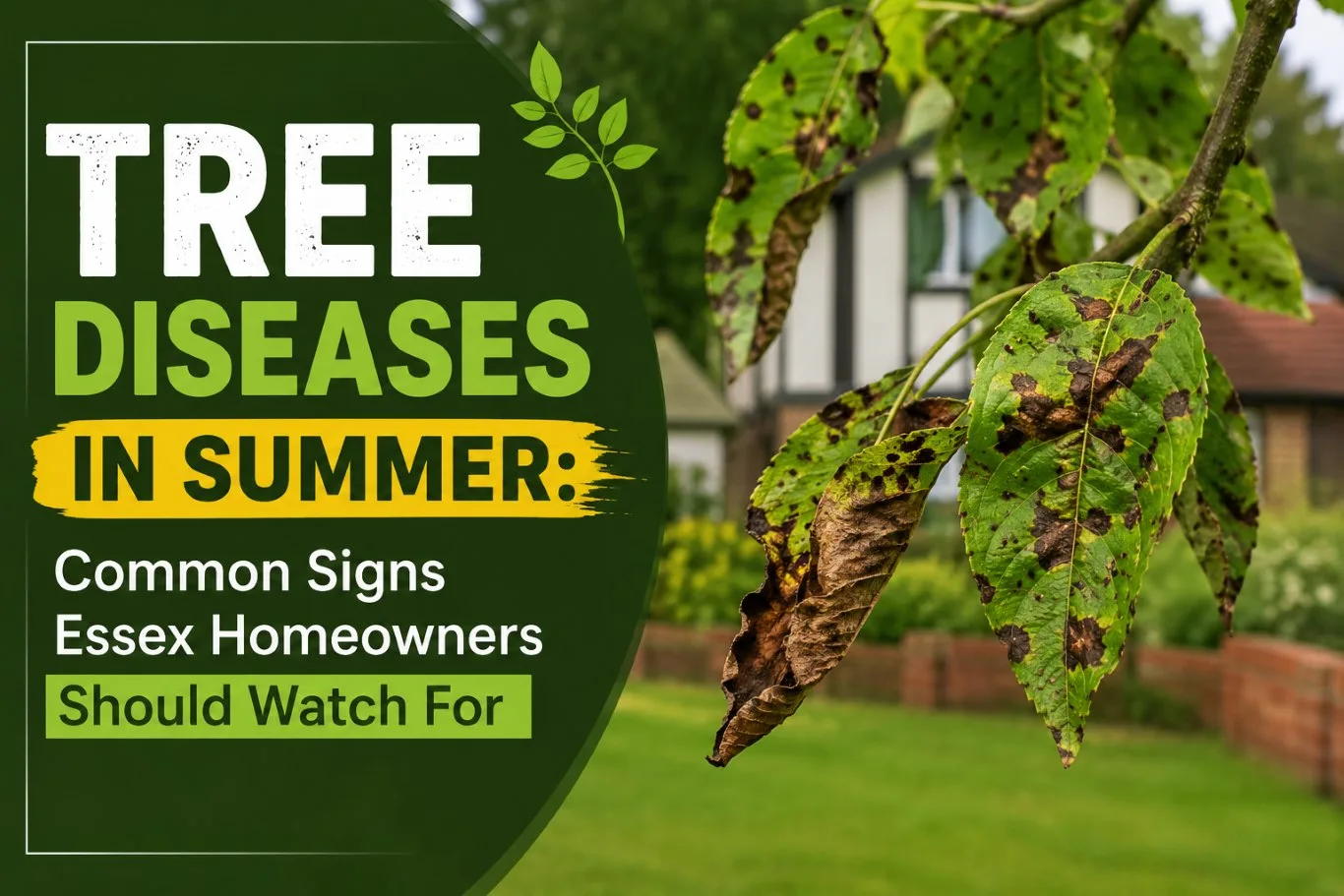
- The Signs: It looks like a fine, dusty white or grey powder scattered across the upper surfaces of the leaves. Over a few weeks, the infected leaves may distort, curl upward, turn yellow, and drop prematurely.
- The Impact: While a mild case of Powdery Mildew is rarely fatal, a chronic infection blocks out sunlight, heavily disrupting photosynthesis and weakening the overall vitality of the tree ahead of the winter months.
2. Fire Blight (Bacterial Infection)
Fire Blight is an aggressive, destructive bacterial disease that primarily attacks trees in the Rosaceae family, including Hawthorn, Rowan, Apple, and Pear trees. It spreads rapidly via pollinating insects and warm splashing rain.
- The Signs: The tips of the branches look like they have been scorched by a literal flame. The leaves turn a distinct dark brown or pitch black and droop downward, but they remain firmly attached to the twig. The tips of new shoots often bend over into a characteristic “shepherd's crook” shape, and oozing cankers may form on the bark.
- The Impact: Fire Blight moves systematically down the vascular system toward the main trunk. If it is left untreated, it can kill an entire mature specimen within a single season.
3. Honey Fungus (Armillaria)
Honey Fungus is arguably the most dangerous fungal pathogen in British gardens, capable of attacking and killing a huge range of woody perennials, hedges, and mature trees.
- The Signs: In the heat of mid-to-late summer, the canopy of an infected tree will show sudden, unexplained wilting and pale, sickly foliage. If you peel back a small strip of bark at the base of the trunk near the soil line, you will find a distinct, creamy-white sheet of fungal tissue that smells strongly of fresh mushrooms. In late summer or autumn, clumps of honey-colored mushrooms may sprout directly from the root flare.
- The Impact: Honey Fungus attacks and decays the root system and the cambium layer at the base of the tree. There is no chemical cure; infected trees must be systematically removed, along with their root plates, to prevent the fungal network from traveling through the soil to neighboring healthy plants.
Discerning Between Drought Stress and Infectious Wilt
When a tree begins dropping its leaves in July or August, homeowners often assume it just needs a good soak with a garden hose. However, mistaking a serious vascular disease for simple drought stress can have devastating consequences for your wider garden.
| Symptom Feature | Simple Drought Stress | Active Vascular Disease (e.g., Verticillium Wilt) |
| Canopy Patterns | Uniform browning or wilting across the entire tree, starting with the outer leaf margins. | Sudden wilting isolated to a single branch, one specific side of the canopy, or scattered random limbs. |
| Leaf Coloration | Leaves turn a crisp, uniform brown or yellow before cleanly falling away. | Leaves often show distinct, irregular yellowing between the veins before drying out completely. |
| Twig Interior | Internal wood beneath the bark remains pale green or creamy-white when lightly scratched. | Shows a distinct dark green, brown, or black streaking inside the wood fibers when inspected. |
| Recovery Rate | Canopies bounce back noticeably after a few deep-soaking watering sessions. | Watering has no positive effect; the affected branches continue to die back systematically. |
If you notice your trees displaying the patterns of an active vascular issue, it is highly advisable to seek advice from certified tree services in the UK immediately. Diseases like Verticillium Wilt or Dutch Elm Disease clog the water-transporting xylem tubes inside the wood, and trying to handle them without professional sanitation protocols can accidentally spread the infection across your entire property boundary.
The Seasonal Relationship Between Pests and Plant Illness
Summer tree care involves managing a complex ecosystem where insects and plant diseases work together to weaken your landscape. Many common garden pests act as vectors, transporting fungal spores and bacteria directly into healthy trees.
Aphids, Scale, and Sooty Mold
Sucking insects like aphids and scale thrive in warm conditions, piercing tender green stems to feed on sap. As they feed, they excrete a sticky, sugary liquid known as honeydew. This honeydew quickly coats the lower leaves, providing the ideal food source for a secondary issue called Sooty Mold. This black, soot-like fungus coats the foliage, blocking light and ruining the appearance of the tree.
Wood-Boring Beetles
When a tree is weakened by a summer heatwave or an underlying root condition, it emits distress chemical signals that draw in wood-boring beetles from miles around. These pests tunnel deep into the bark to lay their eggs. The emerging larvae chew through the vital cambium layer, cutting off the tree's water transport channels and creating easy entry points for destructive wood-rotting fungi.
Strategic Prevention: How to Protect Your Landscape
The most effective way to manage warm-weather tree illnesses is to stop them from establishing themselves in the first place. A few proactive, practical steps can build long-term biological resilience in your garden:
- Implement Deep Watering: Avoid shallow surface spraying. Use a slow-trickle hose method around the canopy dripline to provide deep moisture, ensuring roots stay hydrated and the tree's natural immune system remains strong.
- Apply Organic Mulch: Spread a 5 to 10-centimeter layer of woodchips or composted bark over the root zone to conserve moisture and regulate soil temperature. Always leave a clear 10-centimeter gap around the base of the trunk to prevent moisture retention against the bark.
- Promote Inner Airflow: Schedule professional crown thinning to clear out crowded inner branches. Improving wind and sunlight penetration allows wet leaves to dry quickly after summer rain, stopping fungal spores from germinating.
- Sanitize Gardening Tools: If you are cutting away diseased wood yourself, always disinfect your pruning shears and saws with a garden-safe sanitizing solution between every single cut. Unsanitized blades can easily transport pathogens from a sick branch to a completely healthy tree.
Professional Diagnostics and Liability Management
Attempting to treat a severely diseased tree without professional guidance carries significant risks, both for the health of your garden and the physical safety of your property.
Safe Containment and Disposal
When a tree must be cut back or removed due to an infectious issue like Fire Blight or Honey Fungus, the resulting green waste cannot simply be thrown onto a standard garden compost heap or chipped into garden mulch. Doing so will simply spread the pathogen across your property. Professional arborists use strict containment protocols, ensuring infected timber is isolated, removed safely, and disposed of at licensed deep-composting or incineration facilities to protect the wider environment.
Securing Your Property Assets
A tree structurally weakened by internal decay, root rot, or severe cankers poses a massive liability during sudden summer thunderstorms and high winds. Working with a certified, fully insured firm ensures your property is thoroughly assessed using modern diagnostic techniques. This proactive approach eliminates structural risks and gives you complete peace of mind throughout the seasonal changes.
FAQs
1. Can a tree fully recover from a severe summer fungal infection?
It depends entirely on the specific disease and how early it is treated. Foliar issues like Powdery Mildew are easily managed with structural crown thinning and proper hydration. However, systemic root or vascular issues like Honey Fungus or advanced Dutch Elm Disease usually require complete removal to protect neighboring trees.
2. Should I spray chemical fungicides across my entire garden canopy?
Large-scale chemical spraying is rarely effective or environmentally responsible for mature trees. It can harm beneficial insects, local bird populations, and predatory garden bugs. We prioritize cultural controls, such as improving airflow, correcting soil nutrition, and executing target pruning to manage issues naturally.
3. How quickly can your team assess a suspected tree disease on my property?
We maintain a highly responsive local scheduling system across our coverage network. For standard domestic and commercial health assessments, we can typically arrange a professional on-site visit within 24 to 48 hours of your inquiry.
4. What geographical areas do your diagnostic teams cover?
Our daily service network covers the entire county of Essex, including Chigwell, Loughton, Epping, Woodford, Brentwood, Buckhurst Hill, and adjacent North London areas. Our local presence ensures we understand regional soil types, common tree profiles, and local council planning rules.
5. Are your tree surgeons qualified to handle protected trees with diseases?
Yes. Our entire staff holds verified NPTC and LANTRA qualifications, operating strictly under British Standard BS 3998:2010. If a tree protected by a Tree Preservation Order (TPO) becomes diseased and hazardous, we manage the entire emergency council notification process on your behalf.
Conclusion / Final Thoughts
Maintaining a beautiful, healthy garden requires a watchful eye and a basic understanding of the biological challenges our trees face during the warm weather. By learning to identify the early warning signs of common tree diseases in summer—from foliar powders to localized wilting—you can take action long before an infection causes permanent structural damage or spreads across your boundary lines. Proactive watering, proper mulching, and improving airflow are simple but powerful ways to support your trees when they need it most.
At Chigwell Tree Services, we are dedicated to providing a highly transparent, expert, and client-focused service for residential and commercial landowners alike. We combine a deep understanding of tree biology with modern machinery to deliver reliable, efficient, and clean results. If you are currently searching for highly recommended tree services near me or need to consult certified tree surgeons near me to evaluate a failing canopy, our local specialists are always ready to provide trusted support. Invest in your home’s environmental future today by giving your trees the expert care and protection they need to thrive.
Need Professional Tree Services in Essex?